RSS

Bank of Canada Holds Rate at 2.25% — What It Means for Southern Vancouver Island Homebuyers and Sellers

The Bank of Canada held its overnight rate at 2.25% on March 18, 2026. Here's what the decision means for homebuyers and sellers on Southern Vancouver Island — and what to watch for next.

March 18, 2026

This morning the Bank of Canada did exactly what most economists expected: it held its overnight policy rate steady at 2.25%. It's the second hold of the year, following an identical decision in January, and it leaves borrowing costs essentially unchanged since last fall.

On the surface, a hold sounds like a non-event. But the story behind this decision is more complicated — and worth understanding if you're thinking about buying or selling a home on Southern Vancouver Island in the months ahead.


What the Bank of Canada Actually Said

The Bank held its target for the overnight rate at 2.25%, with the Bank Rate at 2.5% and the deposit rate at 2.20%. Bank of Canada

In its statement, the Bank acknowledged that the Canadian economy continues to adjust to U.S. tariffs and trade uncertainty, but flagged that recent data suggest near-term economic growth will be weaker than anticipated in January, with the labour market remaining soft — employment gains from Q4 2025 were largely reversed in the first two months of 2026, and the unemployment rate climbed to 6.7% in February. BNN Bloomberg

On inflation, the picture is actually pretty encouraging at first glance. CPI inflation eased to 1.8% in February, down from 2.3% in January, and core inflation measures have also come down and are close to 2%. Bank of Canada

So why the hold, rather than a cut? One word: energy. The sharp increase in global energy prices has led to higher gasoline prices, and this will push total inflation higher in the coming months. Bank of Canada The conflict in the Middle East has added a layer of uncertainty the Bank wasn't willing to look past just yet.


The Rate Cut Case — And Why It's on Hold

Here's the honest picture: if it weren't for elevated geopolitical risk and rising oil prices, there's a solid argument that rates should already be moving lower. Core inflation has been decelerating for months. Economic growth is soft. Employment is weak. Under normal conditions, that's a textbook case for cuts.

Instead, the Bank finds itself in a wait-and-see position, trying to separate a potentially temporary energy price spike from a more persistent inflationary shift. Most estimates suggest that a prolonged period of high oil prices could add roughly 1% to consumer inflation — potentially pushing CPI back above 3%. That's a meaningful risk the Bank has to weigh against an already-sluggish economy.

TD Economist Maria Solovieva summed it up well: "When inflation is close to the central bank's target, there is no strong reason to change course. GDP growth is below target, but it's not enough for the Bank to move its interest rate, either." TD

The next rate announcement is scheduled for April 29, 2026, at which point the Bank will also release its quarterly Monetary Policy Report — giving us a fuller picture of where things are headed.


What This Means for the Local Market

For buyers and sellers here in Greater Victoria, the Westshore, Sooke, and the Cowichan Valley, today's hold means a few things practically:

If you're a buyer: Fixed mortgage rates have been relatively stable, and variable rates remain tied to the overnight rate at 2.25%. Lenders aren't pricing in near-term cuts the way they were a few months ago, so the rate environment you're shopping in right now is likely close to what you'll see through spring. It's not a bad time to get pre-approved and lock in certainty.

If you're a seller: Buyer purchasing power hasn't meaningfully changed with today's decision. Demand in our local market continues to be driven by lifestyle factors — the Island's quality of life, remote work flexibility, and relative affordability compared to Metro Vancouver — more than interest rate movements alone.

The bigger wildcard: Energy prices and their downstream effects on inflation will be the thing to watch. If oil stabilizes, the Bank may have room to cut in the summer or fall. If prices stay elevated and push CPI higher, cuts could be pushed further out — or taken off the table entirely for 2026.


The Bottom Line

Today's hold was the cautious, sensible call given genuine uncertainty in the global economy. The Bank isn't slamming the brakes — it's just keeping its foot off the gas until it has a clearer read on where inflation is actually heading.

For most people thinking about real estate on Southern Vancouver Island, this isn't a reason to pause or panic. The fundamentals of our local market — limited supply, consistent demand, and strong community appeal — don't change based on a single rate announcement.

If you're weighing a move and want to talk through what today's news means for your specific situation, I'm happy to chat. 778-400-0475 mike@mikedoughty.ca


Mike Doughty is a REALTOR® with RE/MAX Camosun, serving Greater Victoria, the Westshore, Sooke, and the Cowichan Valley. The views expressed here are for informational purposes and do not constitute financial or mortgage advice.

Read

Canadian Inflation Drops to 1.8% in February — But Don't Get Too Comfortable

Canadian inflation cooled to 1.8% year-over-year in February 2026, with BC coming in at 1.7%. Here's what the latest CPI data means for your wallet — and what's likely coming next.

Published: March 16, 2026 | southislandliving.ca


If you've been keeping an eye on the cost of living lately, February's inflation numbers offer a bit of good news — at least on the surface. Statistics Canada released the latest Consumer Price Index (CPI) data this morning, and the headline number looks encouraging. But dig a little deeper, and the picture gets more complicated.

Here's what you need to know.


Headline Inflation Dips Below 2% — Here's Why

The Canadian CPI rose 1.8% year-over-year in February, down from a 2.3% increase in January. On a seasonally adjusted monthly basis, prices were up just 0.1%. Statistics Canada

That's a meaningful drop, but context matters. The slowdown in year-over-year inflation was largely driven by a base-year effect: back in February 2025, prices jumped when the federal GST/HST tax holiday ended partway through the month. That monthly spike in early 2025 fell out of the 12-month comparison this year, artificially pulling the headline number lower. Statistics Canada

In short — inflation didn't necessarily slow down because prices stopped rising. It slowed partly because prices spiked at this time last year, making year-over-year comparisons look more favourable.

Restaurant meals were the biggest beneficiary of this base-year effect, with annual inflation in that category cooling to 7.8% in February from 12.3% in January. BNN Bloomberg


What's Actually Getting More Expensive

Even with the headline number trending down, some categories are still putting real pressure on household budgets.

Food remains a sore spot. Nationally, food prices rose 5.4% year-over-year in February — a significant improvement from the 7.3% pace recorded in January, but still well above overall inflation. Grocery prices rose 4.1% annually in February, moderating from 4.8% in January, with fresh and frozen beef cooling to a 13.9% annual increase — nearly five percentage points lower than the month before. BNN Bloomberg

In BC specifically (see the chart above), food was up 4.5% year-over-year in February, down from 6.1% in January — a welcome improvement, but still a noticeable hit at the checkout counter.

Health and personal care also continues to climb, with BC seeing a 4.4% year-over-year increase in February (down slightly from 5.3% in January).

On the brighter side, gasoline and transportation costs are providing meaningful relief. BC gasoline prices fell 11.6% year-over-year in February, and transportation overall dropped 1.0%. Cellular service prices also fell on a month-over-month basis, helping pull the overall rate lower. Narcity

Shelter costs in BC rose 1.5% year-over-year — actually a slight improvement from 1.8% in January, and well below the peak pressure we saw in 2022–2023.


How Does BC Stack Up?

British Columbia came in slightly below the national average. Consumer prices in BC rose 1.7% year-over-year in February, down 0.3 percentage points from January. Provinces with HST — like Ontario and those in Atlantic Canada — were more heavily impacted by the base-year effect from the 2025 tax break, as PST was not included in the relief in provinces like BC where federal and provincial sales taxes aren't combined. Statistics Canada

That means BC's disinflation is somewhat more "real" than what we're seeing in some other parts of the country — a sign that underlying price pressures here are genuinely easing.


Core Inflation: The Number That Really Matters

Beyond the headline figure, economists and the Bank of Canada pay close attention to "core" inflation measures, which strip out volatile components like energy and food to give a cleaner read on underlying price trends.

The two Bank of Canada preferred measures — CPI-median and CPI-trim — both fell to 2.3% year-over-year in February, each moving closer to the Bank's 2% target. CPI-common dropped from 2.7% to 2.4%, while CPI-median and CPI-trim each fell to 2.3%, the lowest levels in some time. CBC News

Perhaps most telling: 3-month annualized core inflation has cooled to just over 1% — levels not seen since May 2020. That's a significant signal that underlying price momentum has genuinely slowed.


What This Means for the Bank of Canada

All eyes are now on the Bank of Canada's interest rate decision this Wednesday. On the surface, cooling inflation and a weakening labour market would normally make a strong case for another rate cut.

As BMO chief economist Douglas Porter noted, with most measures of core inflation near the 2% target, policymakers can more readily "look through" any oil-driven spike that may be coming in headline inflation over the next few months — particularly given that employment was already weakening before recent global developments, and with the uncertain fate of Canada's trade relationship with the U.S. still unresolved. CBC News

However, there's a significant wildcard: the US-Iran conflict began on the last day of February, and its full impact on energy prices won't show up until next month's inflation report. Some economists expect gas prices could spike as much as 15%, which would drive headline inflation back toward 3% in the coming months. CBC News

Given that backdrop — strong core disinflation on one hand, and an emerging oil price shock on the other — the Bank of Canada is widely expected to hold rates steady on Wednesday as it assesses how deep and how lasting the supply disruption from rising oil prices will be.


The Bottom Line for Vancouver Island Households

February's inflation data is genuinely good news in several ways. Core prices are cooling, shelter costs are moderating, gasoline has been providing relief at the pump, and food inflation — while still elevated — is moving in the right direction.

But there's no guarantee this trend continues. The coming months are likely to bring renewed upward pressure on energy prices, which will filter through to transportation, goods, and eventually food. The Bank of Canada has a delicate balancing act ahead of it.

For Island families, the practical takeaway is this: the worst of the post-pandemic inflation surge is firmly behind us, and conditions are genuinely more stable than they were two or three years ago. Whether that stability holds through 2026 will depend on factors largely outside Canada's control.

Stay tuned — and as always, if you have questions about how economic conditions are affecting the Southern Vancouver Island real estate market, feel free to reach out.


Mike Doughty | RE/MAX Camosun 📞 778-400-0475 | ✉️ mike@mikedoughty.ca | 🌐 www.southislandliving.ca

Read

What February's Provincial Real Estate Numbers Mean for South Island Buyers and Sellers

February 2026 BC real estate stats show a slower market province-wide, but Southern Vancouver Island and Greater Victoria are holding steady. Here's what the numbers mean for buyers and sellers on the South Island.

Market Update | March 2026

If you've been keeping an eye on BC's housing market, you've probably noticed the headlines aren't exactly cheerful. The province-wide numbers for February 2026 tell a story of a market in a bit of a holding pattern — but what's happening at the provincial level and what's happening here on Southern Vancouver Island are two different conversations worth having.

Let's dig in.

The Big Picture: BC's Market Is Quiet

The British Columbia Real Estate Association (BCREA) released its February 2026 statistics this week, and the headline numbers reflect a market that's still finding its footing. Across the province, residential sales were down nearly 10% compared to February 2025, with the average home price settling at $932,243 — a drop of about 3% year-over-year. Total sales volume province-wide came in at $4.21 billion, down 12.3% from the same month last year. BC unit sales were also sitting roughly 33% below the 10-year average for February — a notable gap that speaks to how much buyer hesitation has shaped this market cycle.

BCREA Chief Economist Brendon Ogmundson acknowledged the sluggishness but pointed to a potential upside: improved affordability conditions in many regions, combined with stable interest rates, could be the catalyst that starts pulling more buyers off the sidelines as spring approaches.

Year-to-date, the provincial numbers are even more sobering — residential sales volume down 17.8% and unit sales off 15.8% compared to the first two months of 2025.

But — and this is important — the South Island market is telling a more nuanced story.

The South Island: Holding Its Own

When you break the provincial data down by board, Greater Victoria and Vancouver Island both show year-over-year softness, but they're outperforming some of the harder-hit markets in the province considerably.

The Victoria Real Estate Board (VREB) reported 465 properties sold across the region in February — down 11.9% from February 2025, but a significant 37% jump from January's pace. That month-over-month acceleration is an encouraging sign that buyers are starting to re-engage as we move into spring.

Single family home sales came in at 206 units, down 12% year-over-year, while condo sales saw the biggest dip — 154 units sold, off nearly 20% from a year ago. The condo segment has been the softer part of the market for a while now, and that trend is continuing.

On the Vancouver Island board (which covers areas like the Cowichan Valley and up-island), 443 units sold in February at an average price of $719,111 — down just 1.9% from a year ago. That modest price dip, combined with a sales-to-active-listings ratio of 15.2%, tells us the Island market, while cooler, remains more stable than many parts of the province.

What About Prices?

The MLS® Home Price Index benchmark for a single family home in the Victoria Core came in at $1,307,400 in February — down less than 1% from a year ago, and actually up from January's benchmark of $1,265,500. That's a meaningful month-over-month recovery that suggests the floor is holding.

Condo benchmarks in the Victoria Core landed at $545,600, also down less than 1% year-over-year. Again, relative stability compared to what's happening in many other parts of BC.

Compared to the broader BC average of $932,243, the Victoria board's average of just over $1 million still reflects the premium that comes with living in one of Canada's most desirable regions — but that premium has narrowed slightly, which is genuinely good news for buyers who've been waiting for a better entry point.

What This Means If You're a Buyer

This is arguably the most buyer-friendly market Southern Vancouver Island has seen in a few years. Inventory is up — there were 2,903 active listings across the VREB region at the end of February, a 10.4% increase from a year ago. More choice, more time to make decisions, and more room to negotiate conditions into your offers. If you've been watching from the sidelines waiting for the right moment, spring 2026 is worth a serious look.

What This Means If You're a Seller

The market is balanced — not crashed, not booming. Homes that are priced right and presented well are still moving. The key word there is "priced right." With more inventory available, buyers have options and they know it. Overpriced listings are sitting longer, and the market is rewarding sellers who are realistic about value from day one. If you're thinking about listing this spring, connecting with a local REALTOR® who knows your specific neighbourhood — not just the broad market averages — is more important than ever.

The Bottom Line

BC's housing market is navigating a challenging stretch, no question. But Southern Vancouver Island continues to demonstrate the resilience that makes this region stand out. Prices are stable, inventory is healthy, and the month-over-month momentum heading into spring is encouraging. This isn't a market to fear — it's a market to understand.

If you have questions about what these numbers mean for your specific situation on the South Island, feel free to reach out. I'm always happy to talk real estate.

Mike Doughty | REALTOR® | RE/MAX Camosun 778-400-0475 | mike@mikedoughty.ca | southislandliving.ca

Read

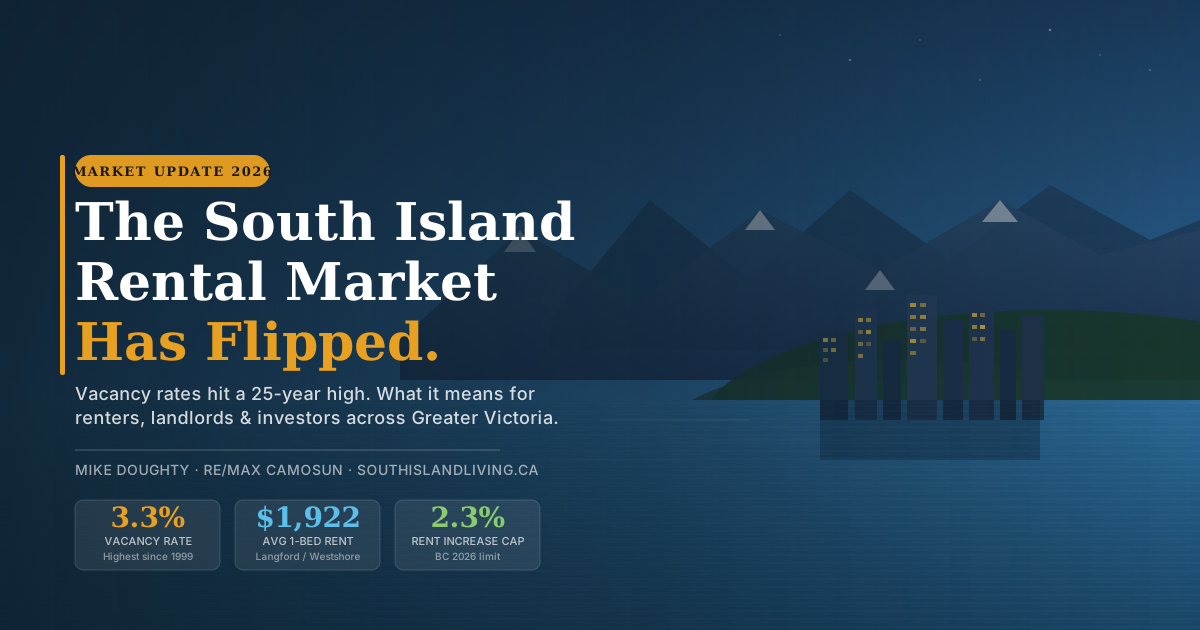
The South Island Rental Market Has Flipped — Here's What That Means for Renters and Investors in 2026

The rental market on Southern Vancouver Island has shifted dramatically. Vacancy rates are at a 25-year high, rents are softening, and renters finally have options. Here's what's happening — and what it means for you.

If you've been renting on Southern Vancouver Island for the past several years, you already know how brutal it's been. Sub-1% vacancy rates. Multiple applications for a single unit. Landlords hold all the cards. For a long time, the rental market here felt less like a free market and more like a scramble.

That era is over — at least for now.

The rental landscape across Greater Victoria, the Westshore, and much of Vancouver Island has shifted significantly heading into 2026. Vacancy rates have hit levels not seen since the late 1990s, rents are softening in many areas, and renters are finally sitting across the table with some negotiating power. Whether you're a renter, a landlord, or someone wondering whether it makes more sense to buy or keep renting, here's what the data actually shows — and what it means on the ground.


Vacancy Rates: A 25-Year High

The headline number is hard to ignore. Greater Victoria's vacancy rate rose to 3.3%, the highest it's been since 1999, according to the CMHC's 2025 Rental Market Report. To put that in context, the vacancy rate stood at just 1.4% as recently as October 2022. That's a dramatic reversal in a very short window of time.

What drove the shift? Two big forces are working at the same time:

New supply hit the market. Between October 2024 and September 2025 alone, 882 new housing units were completed in Victoria — surpassing the Province's own target of 766 units for that period. Much of this new supply is concentrated in Saanich and the Westshore, particularly Langford. The CMHC report notes that vacancy rates increased significantly in the downtown core and Saanich, largely due to higher rental supply in these areas.

Short-term rentals returned to the long-term market. Provincial regulations on platforms like Airbnb pushed thousands of units back into the long-term rental pool. B.C. continues to lead the country in asking-rent declines, down 8.5% over the past two years, with short-term rental restrictions cited as a key factor.

Demand softened. Victoria has faced outflows of international migrants and students, along with a weaker labour market for younger people, both of which reduced rental demand. Fewer new households forming means fewer renters entering the market.


What's Happening to Rents Across the South Island?

The picture on rents is a bit more nuanced than the vacancy story suggests. Asking rents — what landlords are listing units for — have been declining across most of the region. But average rents in purpose-built buildings have actually gone up in some areas, driven largely by turnover: when a unit changes hands, it resets to market rate.

Here's a regional snapshot of approximate average rents based on current market data:

Region1-Bedroom Avg2-Bedroom AvgMarket Feel
Victoria (Core)$1,983$2,547Cooling / High Supply
Saanich$1,900$2,500Seasonal Easing
Langford/Colwood$1,922$2,499Competitive / Incentives
Duncan$1,300$1,600Strong / Affordability-Driven
Nanaimo$1,650$2,200Moderate Stability
Sooke$1,500$1,950Softening / Value-Focused

A few things stand out here. Duncan continues to punch above its weight — strong demand relative to price makes it one of the more stable rental markets on the Island, especially for renters priced out of Victoria. Sooke is softening a bit, which tracks with its distance from employment centres. And Langford — which has seen a flood of new purpose-built supply — is in what the CMHC describes as a "highly competitive" position, with landlords now offering incentives that were unthinkable just two years ago.


The Westshore: Ground Zero for the Shift

If you want to understand where the rental market transition is most visible, look at Langford and Colwood. The Westshore absorbed a disproportionate share of new construction over the past few years, and that supply is now competing for tenants all at once.

The result? Landlords in the Westshore are increasingly using signing bonuses, a free month's rent, or moving allowances to attract tenants — rather than permanently lowering their monthly asking price. It's a strategy designed to protect long-term asset value while staying competitive in a crowded market.

For renters, this is genuinely good news. If you're looking at a new building in Langford right now, it's worth asking about the incentives on the table. There's a decent chance something is available.


What This Means for Landlords and Investors

If you own a rental property on the South Island, the 2026 rent increase cap is set at 2.3%. That's not nothing — but with vacancy up and more competition for tenants, the real priority right now isn't maximizing annual increases. It's keeping good tenants in place.

A vacancy in a softening market is expensive. Between lost income, turnover costs, and the time to lease a unit back up, losing a reliable tenant can easily cost two to three months' rent. The math strongly favours retention.

A few things worth focusing on right now:

  • Keep up with maintenance. In a market where renters have options, deferred repairs are a reason to leave.

  • Highlight value-adds in your marketing. In-suite laundry, parking, storage, and transit proximity matter more than ever when competition is high.

  • Think carefully about new investment underwriting. The era of banking on aggressive rent resets between tenancies has paused. Conservative projections are the right call right now.


Is It Better to Rent or Buy Right Now?

This is the question I get more often than any other lately, and the honest answer is: it depends on your situation.

What I can say is that the rental market cooling doesn't necessarily mean buying is the wrong move — especially if you're planning to stay on the Island long-term, building equity matters to you, and you're in a stable financial position. What it does mean is that renters are no longer being forced into rushed buying decisions just to escape an impossible rental market. You have a little more breathing room to make the right choice for your life.


The Bottom Line

The South Island rental market in 2026 is going through a genuine reset. With more renters looking and prices starting to ease, the outlook heading into the 2026 rental season is mixed — demand remains strong, particularly in lifestyle-driven markets like Victoria, but the increase in supply and higher vacancy rate appear to be cooling upward pressure on prices.

This isn't a market in crisis — it's a market normalizing after years of extreme scarcity. For renters, that's long-overdue good news. For landlords and investors, it's a reminder that thoughtful, relationship-based property management wins over the long run.

Vancouver Island is still one of the best places in the country to live. That hasn't changed. The market dynamics around it just got a little more balanced.


Have questions about how the current rental market affects your real estate plans? Whether you're thinking about buying, investing, or just figuring out your next move, I'm happy to talk it through.

Mike Doughty | RE/MAX Camosun | 778-400-0475 | mike@mikedoughty.ca | www.southislandliving.ca

Read

Cowichan Valley Real Estate Market Update — February 2026

Cowichan Valley real estate market update for February 2026. See current benchmark prices, how the Valley compares to other Vancouver Island communities, and what it means for buyers and sellers this spring.

If you've been watching the Cowichan Valley real estate market, February brought some encouraging signals heading into spring. Sales were quieter than a year ago, but prices are holding steady, townhouses are appreciating nicely, and buyer activity is building across Vancouver Island as the season shifts.

Here's a full breakdown of what the numbers are telling us — and what it means if you're thinking about buying or selling in the Cowichan Valley this spring.


Cowichan Valley Home Sales: February 2026

In February 2026, 31 single-family homes sold in the Cowichan Valley, compared to 48 in February 2025 — a decrease of about 35% year over year. That's a notable drop, but worth putting in context: January 2026 was actually one of the stronger months for the Valley (36 sales), so the market here has been active heading into the year. The broader island-wide rebound in single-family sales — up 78% from January to February — suggests buyers are coming off the sidelines, and the Cowichan Valley typically follows that trend with a bit of lag.

Active listings are rising across Vancouver Island, which is healthy. More inventory means more choice for buyers, and it creates the kind of balanced conditions where both sides of a transaction can feel good about the outcome.


Cowichan Valley Home Prices: What's the Market Doing?

Single-Family Homes

The benchmark price for a single-family home in the Cowichan Valley is $756,800 in February 2026, according to the MLS® Home Price Index (HPI). That's:

  • Up 1.2% from February 2025 ($747,500 one year ago)

  • Up from $751,800 in January 2026

The average sale price came in at $819,866, with a median of $770,000. Steady, measured appreciation. No dramatic swings — just a market building value over time.

Townhouses in the Cowichan Valley

Townhouses are a standout story right now. The benchmark townhouse price is $533,100, which represents a 4.6% increase year over year — one of the stronger year-over-year gains on Vancouver Island. For buyers priced out of the detached market, or investors looking for lower-maintenance properties, Cowichan Valley townhouses are worth a serious look.

Condos and Apartments

The apartment benchmark sits at $310,200, down about 4.5% from a year ago. This is the most affordable entry point in the Cowichan Valley market and one of the lowest condo benchmarks on all of Vancouver Island. For first-time buyers or those looking to downsize without leaving the area they love, this segment still offers genuine value.


How Do Cowichan Valley Home Prices Compare to the Rest of Vancouver Island?

One of the strongest arguments for buying in the Cowichan Valley is the price-to-lifestyle ratio. Here's how the Valley stacks up against other major markets on the Island right now:

AreaSFH Benchmark PriceYear-Over-Year Change
Campbell River$674,900+1.9%
Cowichan Valley$756,800+1.2%
Nanaimo$807,200+0.5%
Comox Valley$834,300+1.4%
Parksville / Qualicum$906,500+4.1%
Vancouver Island (Board-wide)$772,300+1.3%

The Cowichan Valley sits below the island-wide average and is meaningfully more affordable than Nanaimo, Comox Valley, and Parksville/Qualicum — while offering a lifestyle that rivals any of them. Wineries, lakes, trails, a thriving local food scene, and an easy commute to Greater Victoria make this one of the most compelling value propositions on the Island.

For buyers relocating from Victoria or the Westshore, the math is especially interesting — you can often buy significantly more home in the Cowichan Valley for the same budget. [→ Internal link: Cowichan Valley Neighbourhood Guide]


What's Driving Cowichan Valley Real Estate in 2026?

A few things are worth watching this year:

Spring momentum is building. The VIREB's own CEO noted that REALTORS® across the Island are feeling optimistic about 2026, and that activity is picking up across all property types. Historically, the Cowichan Valley spring market runs March through June — that window is opening now.

Affordability relative to Victoria remains a draw. With Greater Victoria benchmark prices consistently well above $900,000+ for single-family homes, the Cowichan Valley continues to attract buyers who want more space, more land, and more lifestyle — without the Victoria price tag. [→ Internal link: Living in the Cowichan Valley]

The provincial PST change on real estate services. BC's Budget 2026 introduced a provincial sales tax on certain real estate and property management services. It's a new variable in the market that VIREB will be monitoring — and something buyers and sellers should be aware of when budgeting transaction costs.


Buying or Selling in the Cowichan Valley This Spring?

Thinking of selling? The benchmark is up year over year and the market is moving. Proper pricing and presentation are everything right now — buyers are active but they're informed, and overpriced homes are sitting longer than they need to. A conversation about your home's current market value costs nothing and tells you a lot.

Thinking of buying? Inventory is up from a year ago, which gives you more options than the tight market conditions of a few years back. With prices stable and spring bringing new listings, the next 60–90 days are prime time to be actively searching. Getting pre-approved and having a clear wish list before the busy season hits gives you a real advantage.

[→ Internal link: What to Know Before Buying in the Cowichan Valley] [→ Internal link: How to Prepare Your Cowichan Valley Home for Sale]


Let's Talk

I'm Mike Doughty, a REALTOR® with RE/MAX Camosun, and the Cowichan Valley is one of my core markets. My family has been on Vancouver Island for six generations, and I genuinely love this part of the Island — I'm not just selling it, I live and breathe it.

Whether you're buying, selling, or just want to understand what your home is worth in today's market, I'm happy to have that conversation.

📞 778-400-0475 📧 mike@mikedoughty.ca 🌐 www.southislandliving.ca


Data sourced from the Vancouver Island Real Estate Board (VIREB) February 2026 Monthly Statistics Package. Benchmark prices reflect the MLS® Home Price Index (HPI). Statistics are board-wide and zone-specific; individual property values may vary.

Read

Victoria Real Estate Market Update – February 2026: Signs of Life Heading Into Spring

The Victoria real estate market showed encouraging momentum in February 2026. Read Mike Doughty's full market update covering home prices, condo trends, and what to expect this spring on Southern Vancouver Island.


If you've been watching the Victoria real estate market and wondering when things might start picking up — February gave us some pretty encouraging signs.

A total of 465 properties sold across the Victoria Real Estate Board region in February 2026. That's up 37.2% from January, which is a meaningful jump. Yes, we're still running about 11.9% below February 2025 numbers, but the momentum is real and the spring market is shaping up to be interesting. As a sixth-generation Vancouver Islander who's seen a few market cycles, I'd say the fundamentals right now are pretty solid for anyone thinking about making a move.

Let's break it down.


Single Family Homes – Prices Stabilizing

206 single family homes sold in February, down 12% from the same time last year. On the price side, the MLS® HPI benchmark for a single family home in the Victoria Core is sitting at $1,307,400 — that's down just 0.9% year-over-year, but notably up from January's benchmark of $1,265,500. That month-over-month bounce is worth paying attention to.

If you're looking at the Westshore — Langford, Colwood, View Royal — the benchmark single family price is $1,004,800, making it one of the more accessible entry points for families wanting a detached home within commuting distance of Victoria.


Condos – A Buyer's Window That May Be Closing

154 condos sold in February, down 19.8% year-over-year. Condo prices have softened slightly over the past year — the Victoria Core benchmark sits at $545,600 (down 0.7% from February 2025), and the Westshore condo benchmark is $510,200.

Here's what's interesting though: month-over-month, condo prices are trending upward across every region. If you've been sitting on the fence about buying a condo in Victoria or Langford, the window of softer pricing may not stay open much longer.


Townhomes – The Standout Performer

Townhomes were the bright spot of the month. 66 sold in February — up 11.9% compared to February 2025, making it the strongest-performing segment by year-over-year sales. The benchmark price for a townhome in the Victoria Core is $842,800, while the Westshore comes in at $709,000.

For buyers who want more space than a condo but aren't quite at the detached home price point, townhomes continue to offer strong value — especially on the Westshore.


What Kind of Market Are We In?

The short answer: balanced — and that's actually a good thing.

The Sales to Active Listings Ratio is sitting right in the balanced range (between 17% and 28%), which means neither buyers nor sellers hold a strong advantage. There are currently 2,903 active listings on the market — up 10.6% from January and 10.4% higher than this time last year. Buyers have solid selection right now across all property types and price points throughout Greater Victoria, Langford, Saanich, Oak Bay, and beyond.

Victoria Real Estate Board Chair Fergus Kyne summed it up well: "When the market is in balance, it means excellent opportunities exist for buyers and sellers."

Hard to argue with that.


What to Expect This Spring

The spring market traditionally brings more listings, more buyers, and more activity — and all the signals point to 2026 being no different. The month-over-month surge in February sales, combined with healthy inventory levels, sets the stage for a busy few months ahead.

If you're thinking about selling your home in Victoria, Langford, Colwood, Saanich, or anywhere across Southern Vancouver Island, now is the time to start planning — not when the "For Sale" signs start popping up on your street. And if you're a buyer, you have more selection and more negotiating room than you've had in years. That combination doesn't last forever.


Thinking About Buying or Selling on Vancouver Island?

I'm Mike Doughty, REALTOR® with RE/MAX Camosun, and I've been helping buyers and sellers navigate the Southern Vancouver Island market for years — backed by six generations of Island roots and a genuine love for this place.

Whether you're looking at Victoria, Langford, the Westshore, the Cowichan Valley, or anywhere in between, I'd love to help you make a smart, confident move.

📞 Give me a call, shoot me a text, or reach out through the contact form below. Let's talk about what the February 2026 numbers mean for your situation.


Data sourced from the Victoria Real Estate Board MLS® Statistics Package, February 2026. MLS® HPI benchmark prices reflect the Victoria Core and Westshore regions.

Read

Preparing Your Home for Sale: The Complete Guide

For First-Time Sellers in Langford & Colwood

Selling your home — especially your first one — is exciting, but it’s also a project. Buyers form opinions in a matter of seconds, and the way your home shows matters. The good news? With the right prep, you can confidently put your property in front of buyers and maximize interest (and offers) in our Westshore market.

This is your roadmap to preparing your home for sale — practical, actionable, and designed for first-time sellers in Langford and Colwood.


1. Start with a Deep Declutter + Clean

Before you think about paint or repairs, start here.

Why it matters:
Decluttering makes spaces feel larger and more inviting. In a market like Langford and Colwood — where buyers are often looking for space to entertain or raise a family — a clean, open home sells.

What to do:

  • Pack seasonal items and personal photos.

  • Clear countertops and flat surfaces.

  • Free up closet space — buyers will open them.

  • Rent a small storage unit or PODS for furniture you don’t need during showings.

  • Clean from top to bottom (floors, windows, bathrooms, caulking, grout).

A professional cleaning can be worth its weight in buyer confidence.


2. Repair What Needs Repair — But Be Smart About It

Buyers notice small things immediately — a squeaky door, a leaky faucet, a burned-out lightbulb. Those little details subconsciously lower the value in a buyer’s mind.

Checklist:
✔ Fix doors that don’t latch
✔ Repair cupboards and drawers that stick
✔ Replace cracked tiles
✔ Touch up scuffed walls
✔ Clean or replace old weatherstripping

Major systems:
Roof, HVAC, hot water tank, electrical panels — buyers will ask about these. If they’re nearing end-of-life or in need of attention, be ready with information or quotes. Transparency builds trust and avoids surprises during inspections.


3. Paint — Neutral and Consistent

Fresh paint delivers one of the highest returns on investment for home sellers.

Keep it simple:

  • Light neutrals (off-white, warm greige) appeal to more buyers.

  • Focus on high-visibility areas: entry, living room, kitchen, master bedroom.

In Langford and Colwood, buyers are picturing everyday life — breakfast nooks, family evenings, pets playing. Clean, neutral walls give them a blank canvas.


4. Update Fixtures + Hardware for Cohesion

A surprisingly impactful (and budget-friendly) way to polish the presentation is by updating light fixtures and hardware.

Why this matters:
Mismatched finishes (brass in the dining room, chrome in the kitchen, bronze in the bathrooms) signal piecemeal updates — and that distracts buyers.

Focus on:

  • Light fixtures

  • Cabinet pulls and knobs

  • Door handles

  • Faucets

Consistent finishes make your home feel intentional and well-cared-for.


5. Curb Appeal = First Impressions

Buyers start forming opinions before they step inside.

Quick Westshore curb appeal wins:

  • Mow, edge, and weed the lawn

  • Trim hedges and clear walkways

  • Power-wash driveways and decks

  • Paint or clean the front door

  • Sweep paths and porches

In neighbourhoods like Colwood Corners or View Royal, where lots are visible from the street, having tidy, inviting landscaping matters.


6. Staging — Let Buyers See Possibility

Staging isn’t about putting your home in a magazine — it’s about helping buyers see themselves living there.

Tips if you’re staging yourself:

  • Arrange furniture to show clear purpose for each room

  • Don’t over-decorate — keep it simple

  • Scale furniture to the room size

  • Keep beds made and bathrooms minimalist

If budget allows, a professional stager can deliver big impact — especially for living rooms and primary bedrooms.


7. Price It Right

We can’t overstate this: a strategic price gets attention. Especially in the Westshore, where inventory fluctuates, pricing correctly from day one is one of the biggest factors in getting multiple offers.

Overpricing leads to stale listings — even if your home is beautifully prepared.


Your Next Step

Selling your first home in Langford or Colwood doesn’t have to feel overwhelming. With the right prep and a clear plan, you can show your home in its best light and attract confident buyers.

If you’re thinking about selling and want a personalized prep plan that matches your timeline and budget, let’s connect. I’ll walk you through the steps, what’s worth investing in, and how to price it right for our market.

📞 Contact Mike Doughty
RE/MAX Camosun
Your Westshore Real Estate Specialist

Read

BC Real Estate Stats – December 2025: What Provincial Trends Mean for the Vancouver Island Housing Market

If you’ve been following real estate headlines lately, you’ve probably seen a mix of optimism, caution, and the occasional “the sky is falling” hot take. As usual, the truth lives somewhere in the middle.

The latest BC real estate stats for December 2025 show a provincial market that’s continuing to recover — but doing so unevenly, region by region. Some areas are clearly gaining momentum, others are still working through affordability and confidence issues, and here on Vancouver Island, the story is far more balanced than many people expect.

Let’s break down the monthly real estate trends in BC, then zoom in on what they actually mean for buyers, sellers, and investors living the Vancouver Island lifestyle.


BC Real Estate Stats: The Provincial Snapshot

According to the British Columbia Real Estate Association (BCREA), there were 4,271 residential sales across BC in December 2025, down 5.9% year-over-year. The average residential sale price came in at $952,061, a 5.6% decline compared to December 2024.

At face value, that sounds like a soft market — but context matters.

Key Provincial Takeaways (Plain English)

  • Sales activity remains below long-term averages, especially in higher-priced regions

  • Prices are correcting, not collapsing, after the rapid run-up of 2020–2022

  • Inventory is rising, giving buyers more choice and leverage

  • Recovery is uneven, with Interior BC performing much stronger than the Lower Mainland

In short, BC real estate is no longer driven by panic buying or fear of missing out. It’s being driven — once again — by fundamentals.


Around the Province: December 2025 Regional Comparison

Looking region by region helps explain why provincial averages don’t tell the whole story.

Lower Mainland: Still the Provincial Drag

  • Greater Vancouver

    • Average price: $1,189,227 (–7.1% YoY)

    • Unit sales: 1,537 (–12.5% YoY)

  • Fraser Valley

    • Average price: $1,014,684 (–4.8% YoY)

    • Unit sales: 841 (–8% YoY)

Affordability challenges and buyer hesitation continue to weigh on these markets. Even with more listings available, many buyers are taking a “wait and see” approach.


Interior BC: Quiet but Meaningful Strength

  • Okanagan

    • Average price: $784,802 (+5.9% YoY)

    • Unit sales: 476 (+7.7% YoY)

  • Kamloops

    • Average price: $616,624 (+8.1% YoY)

    • Unit sales: 137 (+3% YoY)

  • Kootenay

    • Average price: $535,209 (+1.4% YoY)

    • Unit sales: 153 (+25.4% YoY)

Interior markets are benefiting from relative affordability, lifestyle appeal, and migration from higher-priced urban centres — a theme that sounds very familiar to anyone watching Vancouver Island closely.


Vancouver Island Housing Market: A Different Story

This is where things get interesting.

Despite softer provincial numbers, Vancouver Island continues to show resilience.

Vancouver Island (Overall)

  • Average price: $736,301 (+2.1% YoY)

  • Unit sales: 388 (–8.9% YoY)

Victoria

  • Average price: $1,010,603 (+5% YoY)

  • Unit sales: 346 (–10.6% YoY)

Here’s the key takeaway:

Prices on Vancouver Island are rising modestly even as sales volumes cool.

That combination usually signals a balanced market, not a weak one. Demand hasn’t disappeared — it’s just become more thoughtful.


What This Means Locally (Victoria, Cowichan Valley, Sooke)

Victoria Real Estate Market

Victoria continues to anchor the Island:

  • Strong demand for walkable neighbourhoods

  • Stable employment base

  • Limited land supply

Buyers are more selective, but quality homes priced correctly are still moving.

Cowichan Valley & Duncan

Cowichan remains a value-focused alternative:

  • Popular with downsizers and remote workers

  • Price sensitivity is higher than Victoria

  • Turnkey homes in good locations outperform

Sooke & West Shore

Sooke has matured into a more balanced market:

  • Buyers expect space and value

  • Over-priced listings sit

  • Well-presented homes still attract strong interest

Across the Island, lifestyle continues to drive demand — trails, water access, community, and that unmistakable West Coast living factor.


What Buyers Should Know Right Now

For buyers, this market quietly offers opportunity.

Why buyers have leverage:

  • More inventory than last year

  • Fewer multiple-offer situations

  • Greater willingness from sellers to negotiate

Smart buyer strategies:

  • Focus on homes listed 30+ days

  • Don’t rush — negotiation is back

  • Pay attention to micro-locations, not just price

This isn’t a bargain-basement market, but it is a rational one.


Advice for Sellers in Early 2026

The market still works for sellers — just not on autopilot.

What’s working:

  • Accurate pricing based on recent sales

  • Strong presentation and marketing

  • Flexibility with dates and conditions

What’s not:

  • Testing aspirational prices

  • Ignoring feedback

  • Assuming demand will “eventually catch up”

On Vancouver Island, buyers are informed. Homes that respect that reality sell. Homes that don’t… linger.


Investors: A Market for Patience, Not Speculation

This is not a short-term flip environment — but long-term fundamentals remain strong.

Investor positives:

  • Stable pricing

  • Continued rental demand

  • Less emotional competition

Best strategies:

  • Buy-and-hold

  • Secondary suites

  • Well-located townhomes and condos

West Coast lifestyle markets reward patience more than speed.


Short-Term Forecast: What to Expect Next

Looking ahead to early 2026:

  • Modest improvement in sales activity

  • Gradual inventory growth

  • Stable pricing on Vancouver Island, with pockets of strength

Barring a major economic shock, the most likely scenario is continued balance, not volatility.


Final Thoughts: Why Local Insight Matters

The December 2025 BC real estate stats tell us one thing clearly: real estate is local again.

Provincial headlines only tell part of the story. On Vancouver Island, we’re seeing a market defined by stability, lifestyle demand, and thoughtful decision-making — not fear or frenzy.

If you’d like a neighbourhood-specific breakdown, a pricing review, or just a straight-up conversation about your next move, I’m always happy to help.

👉 Reach out anytime for personalized market insights or to review your real estate goals.

— Mike Doughty
Vancouver Island real estate expertise
Local knowledge. Straight answers.

Read

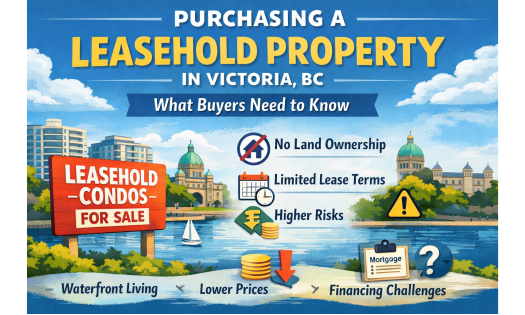
Purchasing a Leasehold Property in Victoria, BC: What Buyers Need to Know

Leasehold properties are a unique — and often misunderstood — segment of the Victoria, BC real estate market. Buyers are frequently drawn in by lower prices, prime locations, or waterfront access, only to realize later that leasehold ownership works very differently than freehold or strata ownership.

In Greater Victoria, leasehold homes and condos are most commonly found in areas like James Bay, Esquimalt, View Royal, Saanich, and select waterfront or reserve lands. Before purchasing a leasehold property on Vancouver Island, it’s critical to understand how these properties work, how financing differs, and what long-term ownership really looks like.

This guide breaks it all down — in plain English.


What Is a Leasehold Property in Victoria?

When you buy a leasehold property in Victoria, you are purchasing the right to occupy and use a home or condo for a fixed period of time, based on a lease agreement. You do not own the land.

The land is owned by a third party, often:

  • A First Nations band

  • A government or crown entity

  • A church or institutional landowner

Lease terms in Victoria typically range from 20 to 99 years, and the number of years remaining on the lease plays a major role in price, financing, and resale value.


Why Victoria Has Leasehold Properties

Leasehold ownership exists in Victoria largely due to:

  • Reserve lands within urban areas

  • Long-held institutional land ownership

  • Historical land use agreements

Because land in Victoria is limited and expensive, leasehold arrangements have allowed development in desirable areas while keeping land ownership intact.


Advantages of Buying a Leasehold Property in Victoria

1. Lower Purchase Prices

Leasehold properties in Victoria are often significantly more affordable than comparable freehold or strata properties. This can allow buyers to enter neighbourhoods they might otherwise be priced out of.

2. Prime Locations

Some leasehold condos are located near:

  • Downtown Victoria

  • The Inner Harbour

  • Waterfront walkways and parks

Location is often the biggest draw.

3. Strata-Like Living

Many leasehold condos operate similarly to standard strata properties, with shared maintenance, amenities, and management — though land rent is an added cost.


Key Disadvantages Buyers Need to Understand

1. You Don’t Own the Land

This limits long-term appreciation and control. At the end of the lease, ownership typically reverts back to the landowner unless the lease is renewed.

2. Financing Is More Restrictive

Not all lenders finance leasehold properties in Victoria. Those that do usually require:

  • A minimum number of years remaining on the lease

  • Larger down payments

  • More conservative lending terms

As the lease gets shorter, mortgage options decrease.

3. Resale Can Be More Challenging

Leasehold properties generally decline in value as the lease term shortens, particularly once the remaining term drops below typical mortgage lengths.

4. Land Rent and Increases

Most Victoria leasehold properties include:

  • Monthly or annual land rent

  • Scheduled increases

  • Clauses that can affect affordability over time

These costs must be reviewed carefully.


Financing a Leasehold Property in Greater Victoria

Mortgage approval depends heavily on:

  • Years remaining on the lease

  • Who owns the land

  • Renewal clauses

  • Overall marketability

Many buyers are surprised to learn that a property can be financeable today but not in 10–15 years. This matters even if you don’t plan to stay long-term.

Working with a local REALTOR® and mortgage professional who understand Victoria leasehold financing is essential.


Leasehold vs Freehold vs Strata in Victoria

Ownership TypeLand OwnershipLong-Term ValueFinancing Ease
FreeholdYesStrongEasiest
StrataYes (shared)StrongEasy
LeaseholdNoLimitedMore restrictive

Leasehold properties are best viewed as a lifestyle purchase, not a traditional long-term investment.


Questions to Ask Before Buying a Leasehold in Victoria

Before making an offer, buyers should clearly understand:

  • How many years remain on the lease?

  • Is lease renewal permitted?

  • How is land rent calculated and increased?

  • Who owns the land?

  • Are there resale or rental restrictions?

  • What lenders will finance this property?

If these answers aren’t crystal clear, that’s a red flag — not a maybe.


Who Should Consider Leasehold Ownership?

Leasehold properties in Victoria can make sense for:

  • Buyers prioritizing location over appreciation

  • Short- to medium-term ownership plans

  • Buyers who understand the lease structure

  • Cash buyers or those with flexible financing

They are not ideal for buyers focused on long-term equity growth or maximum resale flexibility.


Final Thoughts: Leasehold Properties in Victoria Require Extra Due Diligence

Leasehold ownership isn’t bad — but it is different, and in a market like Victoria, those differences matter.

The price might look attractive, but the real value is in understanding:

  • The lease terms

  • The long-term costs

  • The resale realities

If you’re considering a leasehold property in Victoria or the Westshore, having an experienced local REALTOR® review the lease and walk you through the implications can save you from expensive surprises later.

Because when it comes to leasehold real estate, the fine print matters just as much as the view.

Read

Buying a Foreclosure in BC: Big Opportunity or Big Headache?

Every time the word foreclosure comes up in real estate conversations, someone inevitably says:

“That’s where the deals are, right?”

Sometimes — yes.
Often — not exactly.

Buying a foreclosure property in British Columbia can be a smart move, but it comes with unique legal steps, added uncertainty, and fewer buyer protections than a typical MLS® purchase. Before jumping in expecting an easy bargain, it’s important to understand how foreclosures actually work in BC — and where things can get complicated.

Let’s break it down in plain English.


What Is a Foreclosure in British Columbia?

Foreclosures in BC don’t usually look like the dramatic auctions you see on TV. Most are court-ordered sales overseen by the Supreme Court of British Columbia.

In simple terms:

  • A lender takes legal action after mortgage default

  • The court supervises the sale process

  • The lender must demonstrate that fair market value was achieved

The goal isn’t to sell cheap — it’s to recover the debt fairly.


How the Foreclosure Buying Process Actually Works in BC

This is where foreclosure purchases diverge sharply from a normal real estate transaction — and where buyers are often caught off guard.

1. You Submit an Offer (Looks Normal at First)

Initially, things feel familiar:

  • You view the property

  • You submit an offer through your Realtor

  • You negotiate price and terms with the lender

If your offer is competitive, the lender may accept it conditionally.

But that doesn’t mean the deal is done.


2. The Property Often Continues to Be Marketed

Unlike a standard sale, foreclosure listings frequently remain active even after an offer is accepted.

Why?
Because the lender has a legal obligation to show the court they obtained fair market value.

This means:

  • Other buyers can still view the property

  • Competing offers can still come in

  • Your accepted offer is essentially “held in place” as the benchmark

This surprises many buyers — and it’s completely normal in BC foreclosure sales.


3. Court Approval and the “Return Date”

Once an accepted offer is in place, the lender applies to the court for approval. The court sets a return date (sometimes casually referred to as a hearing or trial date).

On that date:

  • The lender presents your offer to the judge

  • The court reviews the sale details

  • Other interested buyers may appear and submit competing bids

Yes — even at this stage.


4. Open Competition Can Happen in Court

At the return date:

  • New bidders must exceed the existing offer

  • Bidding continues until the court is satisfied the best price has been achieved

  • The judge approves the strongest offer

Until that approval happens, nothing is final.


5. Court Approval = Firm Deal

Once the court approves a sale:

  • The deal becomes firm

  • Completion and possession proceed

  • The property is removed from the market

Only at this point is the purchase truly locked in.


One More Curveball: The Owner Can Still Save the Home

This is one of the most misunderstood — and emotionally challenging — aspects of foreclosure purchases in BC.

Right up until very late in the process, the existing owner may still have the right to redeem the mortgage.

That means:

  • They can pay the arrears, penalties, and legal costs

  • The foreclosure action can stop

  • The home never sells

This can happen even after:

  • Your offer is accepted

  • The sale is heading toward court approval

From the buyer’s perspective, this can feel frustrating — but the system is designed to give homeowners every reasonable chance to keep their property.


Foreclosure Timeline at a Glance (Graphic Description)

Foreclosure Purchase Timeline (Typical):

  1. Mortgage default occurs

  2. Lender begins foreclosure proceedings

  3. Property is listed for sale

  4. Buyer submits offer

  5. Lender conditionally accepts offer

  6. Property continues to be marketed

  7. Court return date is scheduled

  8. Competing bids may be presented

  9. Judge approves final sale

  10. Completion and possession

📌 At any point before court approval, the owner may redeem the mortgage and stop the sale.


The Biggest Risks of Buying a Foreclosure

“As-Is, Where-Is” Sales

No repairs. No warranties. No disclosures beyond the bare minimum.

Legal Fine Print (Schedule A)

Foreclosure contracts often remove buyer protections and shift risk entirely onto the purchaser.

Hidden Costs

Potential issues include:

  • Strata arrears

  • Property tax balances

  • Deferred maintenance

  • Title complications

Unpredictable Timelines

Court scheduling and competing offers can extend the process well beyond a standard transaction.


Why Foreclosures Aren’t Always Cheap

In BC, lenders are required to aim for fair market value, not liquidation pricing.

As a result:

  • Many foreclosures are priced close to comparable sales

  • Investor interest can drive competition

  • Discounts tend to reflect condition, not desperation

Foreclosures are not automatic bargains — they’re situational opportunities.


When Buying a Foreclosure Can Be a Smart Move

Foreclosures can work well for buyers who:

  • Are financially prepared

  • Understand renovation and risk

  • Can remain flexible and patient

Upsides may include:

  • Less emotional negotiation

  • Clear motivation to sell

  • Potential for equity growth if purchased well


Tips for Buying a Foreclosure Successfully

  • Work with a Realtor experienced in court-ordered sales

  • Have a real estate lawyer review the contract early

  • Secure financing before writing offers

  • Budget for repairs and surprises

  • Keep backup options available


Foreclosure FAQ (Quick Answers)

Can my accepted foreclosure offer be outbid?
Yes. Competing bids can be presented at the court return date.

Is the deal firm once my offer is accepted?
No. It only becomes firm after court approval.

Can the owner still keep the home?
Yes. The owner may redeem the mortgage right up until late in the process.

Are foreclosures always cheaper than regular listings?
No. Many sell close to market value, depending on condition and competition.

Are foreclosures good for first-time buyers?
Sometimes — but they’re better suited to buyers who can handle risk and uncertainty.


Final Thoughts

Buying a foreclosure in British Columbia isn’t about speed — it’s about process, preparation, and patience.

For the right buyer, with realistic expectations and proper guidance, a foreclosure can be a solid opportunity. For others, it can be more stress than savings.

The key is knowing what you’re walking into before you write the offer.

If you’re curious about foreclosure opportunities — or want an honest opinion on whether one actually makes sense for your situation — feel free to reach out. Sometimes the smartest move is knowing when to wait.

🏡

Read

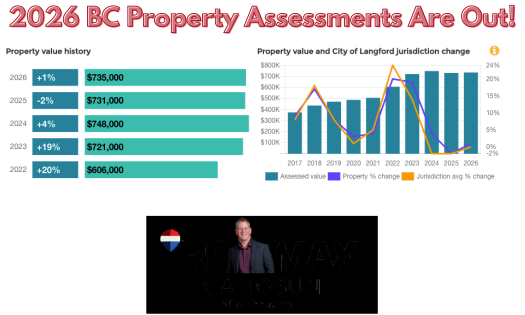
2026 BC Property Assessments Are Out — What Changed, What They Mean, and What They Don’t

BC Assessment has released the 2026 property assessments, and, as usual, this time of year brings plenty of questions from homeowners across Langford, the Westshore, Shawnigan Lake, Cobble Hill, Mill Bay, Duncan and Greater Victoria.

Some people are surprised by the number. Others are relieved. And many wonder the same thing: “Is this what my home is really worth?”

The short answer: assessments are useful — but they’re only one piece of the puzzle.

(The chart above shows how assessed values can change year over year. It’s a good visual reminder that assessments move in cycles and don’t always line up perfectly with today’s market.)


What a BC Assessment Actually Represents

A BC Assessment is an estimate of your property’s market value as of July 1 of the previous year.

That’s the key detail many people miss.

For the 2026 assessment:

  • Values are calculated as of July 1, 2025

  • They are released in January 2026

  • Which means they are already about six months old by the time you receive them

Markets don’t stand still for six months — especially on Vancouver Island. Conditions can shift due to interest rates, buyer demand, inventory levels, and seasonal trends. That’s why assessments should never be relied on as a sole indicator of value.

They’re a snapshot in time — not a live market read.


How Do 2026 Assessments Compare to Last Year?

Compared to 2025, many properties across the region are seeing small to moderate changes, with some up, some down, and others relatively flat.

A few important reminders:

  • Assessments are based on past market data, not current listings

  • Your change matters less than how it compares to similar nearby homes

  • A rising assessment does not automatically mean rising taxes

This is why two neighbours with similar homes can have different assessment changes — and very different tax outcomes.


Do Higher Assessments Automatically Mean Higher Property Taxes?

Not necessarily — and this is where the mill rate system matters.

In BC, property taxes are based on:

  1. Municipal budgets (what the city needs to collect)

  2. The total assessed value of all properties

  3. Your property’s share relative to others

So:

  • If your assessment rose less than the average, your taxes could stay flat or even decrease

  • If municipal spending is controlled, large tax jumps are less likely

  • Assessments themselves don’t create taxes — budgets do

Think of it like dividing a bill at a restaurant. If everyone’s meal goes up, your share might not change much at all.


Why Assessments Are Only One Tool — Not the Final Word

When I help clients value a property, BC Assessment is just one of several tools I look at.

A proper valuation also considers:

  • What the market has done recently

  • What the market is currently doing

  • Recent comparable sales (not just listings)

  • Location, condition, layout, zoning, and buyer demand

Two homes with the same assessment can sell for very different prices depending on timing and market conditions. That’s why assessments are helpful for context — but they don’t replace real-world market analysis.


When an Assessment Might Be Incorrect

Because assessments are done at scale, inaccuracies do happen.

Common issues include:

  • Incorrect square footage or lot size

  • Condition not fully reflected (original vs updated)

  • Overstated views, access, or usability

  • Poor comparable selection

  • Zoning or development limitations

Before appealing, it’s worth reviewing the details and comparing your property to truly similar homes nearby.


How to Dispute Your BC Assessment

If after reviewing everything you believe your assessment is inaccurate, you can take action.

General steps:

  1. Review your property details carefully

  2. Compare against similar assessed properties

  3. Contact BC Assessment for clarification

  4. File a formal appeal if necessary (before the deadline)

You can start the process here:
👉 https://www.bcassessment.ca

Deadlines are strict, so don’t wait if you have concerns.


Final Thoughts

BC Assessments are useful — but they’re not a price tag and they’re not a crystal ball.

They’re a six-month-old snapshot that helps municipalities calculate taxes, and they’re just one of many tools I use when evaluating a property’s true market value.

If you’re unsure whether your assessment makes sense, or you’d like help comparing it to real market data and recent sales, feel free to reach out. A quick conversation can often provide clarity — and sometimes save you money.

Questions? I’m always happy to help.

Read
MLS® property information is provided under copyright© by the Vancouver Island Real Estate Board and Victoria Real Estate Board. The information is from sources deemed reliable, but should not be relied upon without independent verification.