RSS

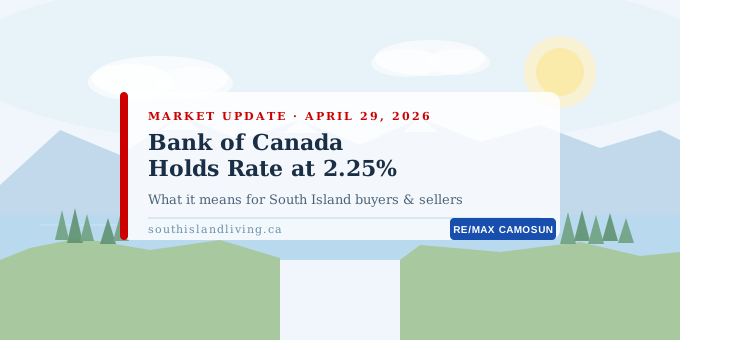
Bank of Canada Holds the Line: What Today's Rate Decision Means for South Island Homebuyers and Sellers

April 29, 2026

The Bank of Canada held its policy rate at 2.25% on April 29, 2026. Here's what that means for mortgage rates, housing affordability, and the real estate market on Southern Vancouver Island.

This morning, the Bank of Canada made its third rate announcement of 2026, and the decision was exactly what most economists had anticipated: hold steady at 2.25%.

For the fourth consecutive time, Governor Tiff Macklem and Governing Council resisted the urge to move in either direction. It's a "wait and see" posture, and given what's happening in the world right now, it's hard to argue with the logic.

So what's going on?

Two big forces are pulling the Canadian economy in opposite directions right now, and the Bank is caught in the middle.

On the one hand, the Canadian labour market is soft. Employment growth has been subdued over the past year, job losses have hit sectors affected by U.S. tariffs, and the unemployment rate is sitting in the 6.5–7% range. Under normal conditions, that kind of labour market weakness would be a clear signal that rate cuts should be on the table. Bank of Canada

On the other hand, the ongoing conflict in the Middle East has sent oil prices sharply higher. The Iran war has led to sharply higher energy prices and transportation disruptions, reducing growth prospects in oil-importing countries and pushing inflation higher worldwide. Bank of Canada

Here's the Canadian twist: higher oil prices are actually a mixed story for us. Canada is an oil exporter, which means higher prices benefit our energy sector even as they hurt consumers at the pump. The Bank noted that these two effects largely cancel each other out, leaving the overall Canadian growth outlook relatively unchanged from earlier this year.

On the inflation front, CPI jumped to 2.4% in March, with forecasts that it will rise to approximately 3% in April due to higher gasoline prices. The Bank expects the spike to be temporary, based on the assumption that oil prices will ease, and inflation is forecast to return to the 2% target early next year. StlawyersBank of Canada

The uncomfortable trade-off

Any central banker will tell you that supply shocks — where prices rise not because of strong demand but because of a disruption to supply — are the hardest situations to navigate. Raise rates, and you risk crushing an already-struggling economy. Do nothing, and you risk higher energy costs feeding into broader price expectations and becoming entrenched.

The Bank's COVID experience looms large here. Its delayed response to rising inflation during 2021–2022 is still fresh in many minds, a reminder that waiting too long can be more costly than acting early. This time around, the Bank appears to be threading the needle: looking through the war's immediate impact on inflation while clearly stating it will not let higher energy prices become persistent inflation. Bank of Canada

TD Economics' outlook is that the Bank of Canada will hold its rate for the duration of 2026 — a view shared by many other economists. Rate cuts remain more likely than hikes, according to several analysts, unless the conflict escalates further and energy prices stay elevated long enough to push core inflation meaningfully higher. TD

What does this mean on Southern Vancouver Island?

The hold is neither exciting nor alarming — and for the South Island market, that's actually okay.

Variable mortgage and HELOC rates will stay where they are. Fixed rates continue to be driven by bond markets, and those have been volatile. If you're holding a variable rate, nothing changes today. If you've been watching from the sidelines, waiting for rates to drop further, the Bank's message is clear: patience is still required. CMP

The South Island market has been navigating its own version of these crosscurrents. Affordability remains a challenge. Housing activity has been held back by slow population growth, economic uncertainty, and ongoing affordability issues. But motivated buyers and sellers are still transacting — and in a market with limited inventory, well-priced properties continue to move. BNN Bloomberg

The next rate announcement is scheduled for June 10, 2026. Between now and then, the Bank will be watching oil prices closely, tracking whether energy costs are bleeding into the prices of other goods and services, and monitoring how the broader Canadian economy is absorbing the dual pressures of tariffs and geopolitical uncertainty.

Whatever happens, I'll be here to help you make sense of it.

Have questions about what today's decision means for your buying or selling plans on the South Island? Feel free to reach out — I'm always happy to talk it through.

📞 778-400-0475 | mike@mikedoughty.ca | [southislandliving.ca]
Read

New Listing Now Available in NS Deep Cove, North Saanich

Just listed at 760 Lands End Rd in North Saanich. See details here

Not all waterfront lots are created equal. Welcome to an exceptional 28,000 sq ft mid-bank oceanfront offering on prestigious Land's End Road—one of Vancouver Island’s most admired luxury addresses. Perched above Satellite Channel with views to Mount Tuam Ecological Reserve, this is a property where the ever-changing coastal scenery becomes part of daily life. Watch yachts pass through the channel, eagles soar overhead, sea lions play below, and whales occasionally surface offshore—all from the future comfort of your custom-built dream home. There is water, hydro and natural gas to the lot and a roughed-in driveway, making the transition from vision to build that much easier. Tucked away at the tip of the Peninsula, yet conveniently close to BC Ferries Swartz Bay Terminal, Victoria International Airport, Horth Hill Regional Park, and the beaches and trails North Saanich is known for. A setting this special is increasingly hard to find. Build something extraordinary here.

Read

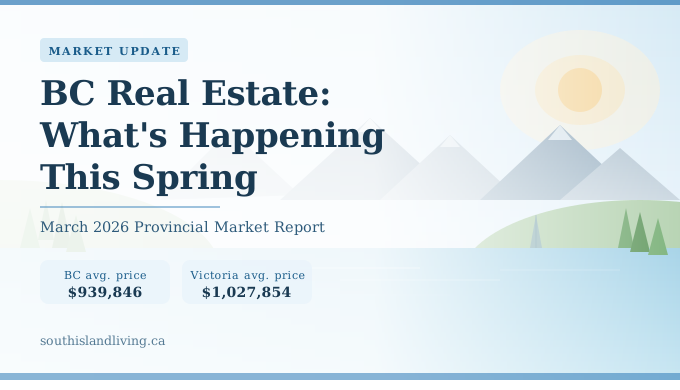
What BC's March 2026 Real Estate Numbers Mean for Life on the South Island

Provincial stats paint a cautious picture — but here on Southern Vancouver Island, the story has some important nuance.

The British Columbia Real Estate Association released its March 2026 provincial market numbers this week, and if you've been following along with the broader economic headlines — tariff uncertainty, global trade tensions, mortgage rate pressure — the data won't come as much of a surprise. But as always, provincial averages tell only part of the story. If you're living on, or thinking about moving to, Southern Vancouver Island, there's context worth understanding.

The Provincial Picture

Across BC, 5,766 residential sales were recorded on MLS® systems in March 2026 — down 3.6% from March 2025. The average residential price province-wide came in at $939,846, a 2% dip from the $959,236 recorded a year ago. Total sales dollar volume reached $4.21 billion, down 5.6% year-over-year, and BC sales are sitting about 34.5% below the ten-year average for March.

BCREA Chief Economist Brendon Ogmundson put it plainly: "Global conflict leading to rising mortgage rates paired with a sluggish economy are presenting a challenge for a housing market recovery. Improved affordability and pent-up demand should translate to an acceleration of activity, though the market will need a period of relative calm for households to build confidence."

Year-to-date through the end of March, provincial sales dollar volume is down 13% to $12.7 billion, with unit sales off 11% at 13,595 and the average price down 2.2% to $933,859 compared to the same stretch in 2025.

How Vancouver Island and Victoria Compare

Here's where it gets interesting for South Island residents.

The Vancouver Island board — which covers communities from the Cowichan Valley north — recorded 606 sales in March at an average price of $769,396, down just 1.3% in price year-over-year and essentially flat on sales volume (-0.7%). Active listings did tick up 3.5%, giving buyers a bit more to work with than they've had in recent years.

Victoria, our own backyard, actually bucked the provincial trend on price. The Victoria board recorded 550 sales at an average price of $1,027,854 — a 4% increase over March 2025. Sales-to-active listings came in at 21.6%, which still reflects a reasonably balanced-to-seller leaning market despite slower overall activity. Active listings grew 7.4%, which signals a gradual normalization of inventory.

What This Means If You're Thinking About a Move

For buyers: more inventory and modest price softening in many BC markets — including parts of our region — means there's room to make thoughtful decisions without the frantic pace of previous years. That's not a bad thing.

For sellers: the Victoria market, in particular, is holding its value better than most of the province. Pricing your home accurately and presenting it well still matters enormously, but the fundamentals here remain solid compared to many other BC communities.

For those on the fence: the BCREA's own economist is pointing to pent-up demand and improved affordability as forces that should drive a recovery — once there's a stretch of economic calm to give households the confidence to act.

Life on Southern Vancouver Island doesn't change with every monthly report. The reasons people want to be here — the lifestyle, the communities, the geography — are durable. But understanding the market environment helps you make smarter decisions when the time comes.

Curious what the numbers mean for your specific neighbourhood or situation? Reach out — I'm always happy to chat.

Mike Doughty | RE/MAX Camosun 📞 778-400-0475 | ✉️ mike@mikedoughty.ca | 🌐 www.southislandliving.ca

Read

New Listing Now Available in La Goldstream, Langford

Just listed at 21 2911 Sooke Lake Rd in Langford. See details here

Affordable living in the Sooke Lake Modular Home Co-op! This 2 bed, 1 bath single-wide offers incredible value with low monthly fees and taxes, all within a secure, community-focused setting. Inside, you’ll find a bright, functional layout with in-unit laundry, a newer hot water tank and fridge, and efficient heating with a pellet stove. Step outside to your private back deck—perfect for morning coffee or relaxing after a day outdoors. The property also includes a small yard, storage shed, and a rare bonus: an attached shop/garage, ideal for hobbies, storage, or a workspace. Located between Goldstream Provincial Park and Sooke Hills Wilderness Regional Park, you’ll enjoy endless hiking and biking trails, while still being just minutes from all the shopping, dining, and everyday amenities of Langford. An excellent opportunity for first-time buyers, downsizers, or anyone looking for an affordable entry into the South Island market without sacrificing lifestyle.

Read

Co-Op Housing in BC: What Buyers and Sellers Need to Know

Thinking about buying or selling co-op housing on Vancouver Island or in Greater Victoria? Here's everything you need to know about how co-ops work in BC — from share ownership to financing quirks and what to expect from the process.

If you've been browsing listings around Greater Victoria or the Westshore and stumbled across a co-op property, you might have done a double-take. Co-ops look a lot like stratas on the surface — shared buildings, common areas, monthly fees — but they work quite differently under the hood. And here on Vancouver Island, where affordability is always top of mind, they're worth understanding.

Whether you're a buyer exploring every option or a current co-op resident thinking about your next move, here's a straight-talking breakdown of what co-op housing actually is, how it works in BC, and what to watch out for.

What Is a Co-Op, Exactly?

A housing co-operative — or co-op — is a form of collective ownership. Rather than buying a unit outright (like you would with a condo), you purchase shares in a nonprofit corporation that owns the building and land. Those shares give you the right to occupy a specific unit and participate in decision-making about how the property is run.

In other words: you're a shareholder and a resident at the same time. You don't hold a title to your unit — you hold shares. It's a subtle but significant legal distinction that affects everything from how you finance the purchase to how you eventually sell.

Co-ops can take many forms: apartment-style buildings, townhouses, duplexes, mobile homes and even clusters of smaller homes. In BC, the model has historically been associated with affordable, community-focused housing, and the province has a well-established co-op sector. British Columbia has over 270 co-ops throughout the province, totalling more than 15,700 units, overseen by the Co-operative Housing Federation of BC (CHF BC). WOWA The majority of housing co-ops in BC are located in Metro Vancouver and on Vancouver Island. CHF BC

How Co-Op Housing Works

When you join a co-op, you're becoming part of a democratically run community. The structure typically looks like this:

A board of directors, elected by shareholders, makes decisions guided by the co-op's bylaws. A co-op association manages the collective finances — collecting monthly fees that cover property taxes, building maintenance, utilities, and any underlying mortgage on the property. As a shareholder, you contribute to these shared expenses and have a voice in how the co-op operates.

Your monthly housing charge covers more than just your unit — it's your share of running the whole building or property. Some co-ops also hire a property management company to handle day-to-day issues.

Co-Op vs. Strata: What's the Difference?

This is where buyers often get tripped up. Both co-ops and stratas involve shared buildings and communal responsibilities, but the ownership structure is fundamentally different.

With a strata, you own your individual unit. You hold the deed. Any appreciation in the value of your unit belongs to you, and you generally have more freedom to renovate, rent, or sell on your own timeline.

With a co-op, you own shares in the corporation that owns the property. You receive stock instead of a title as you would with a traditional home purchase. rocketmortgage Your ability to renovate, sublet, or sell may be subject to co-op bylaws and board approval. That said, co-ops often come with lower purchase prices — a meaningful advantage in high-cost markets.

Buying a Co-Op in BC: What to Expect

If you're considering buying into a co-op, the process differs from a typical real estate transaction in a few key ways.

The application and approval process. Most co-ops require prospective buyers to apply and be approved by the board. Approval is based on your financial stability and sometimes on your compatibility with the co-op's community and values. Co-op boards have the right to approve or reject candidates, which is different from conventional real estate transactions where sellers cannot usually reject a financially qualified buyer. Be prepared to submit financial documentation and, in some cases, character references or an interview.

Financing can be more complex. This is probably the biggest hurdle for buyers. Because you're purchasing shares rather than real property, traditional mortgage financing doesn't always apply. Some lenders are hesitant to provide loans for co-op shares, so it may take time to find a suitable mortgage provider. Interest rates might be higher, and the down payment requirements might also be more substantial compared to other types of properties. Talk to a mortgage broker who has experience with co-op transactions in BC before you get too far into the process.

Review the documents carefully. Once you've found a co-op you're interested in, due diligence is critical. You should inspect the physical condition of the unit and understand the financial health of the co-op. Obtain and review the co-op's financial statements, bylaws, and any other relevant documents. The bylaws will tell you what you can and can't do with your unit — including rules around subletting, renovations, and resale.

Sign a shareholder agreement. Upon acceptance, you'll enter into a shareholder agreement that outlines your rights and responsibilities as a co-op member. This document governs much of your day-to-day life in the co-op, so it's worth reading closely (and ideally having a real estate lawyer review it).

Selling a Co-Op: What You Should Know

Selling a co-op share isn't the same as listing a condo or home on MLS. There are a few things to keep in mind.

The co-op may have resale restrictions. Some co-ops have bylaws that limit how shares can be sold, who can buy them, and what price can be charged. In some cases, the co-op itself has right of first refusal — meaning it can buy the shares back before you sell to an outside buyer.

Resale value can be tied to the co-op's financial health. Resale prices can be influenced by the co-op's financial health and its rules on selling. If the building has deferred maintenance, a large underlying mortgage, or ongoing financial challenges, that can affect what your shares are worth.

New buyers still need board approval. When you sell, your buyer will need to go through the same application and approval process you did. This can add time to a transaction and, in some cases, create complications if a prospective buyer doesn't meet the board's criteria.

Working with a REALTOR® matters. Because co-op transactions involve layers of legal and financial complexity that don't exist in typical home sales, having a REALTOR® and a lawyer who are familiar with co-ops in BC is genuinely important — not just a nice-to-have.

The Pros and Cons of Co-Op Living

Like any housing type, co-ops have real advantages and real trade-offs. Here's a balanced look:

Why co-ops can be a great fit: Lower purchase prices compared to equivalent condos in many markets. A built-in sense of community and shared responsibility. Reduced individual maintenance burden. Potential tax benefits in some circumstances (consult a tax professional). Long-term stability — many co-ops in BC have been well-managed for decades.

Where co-ops require more thought: The application and approval process adds time and uncertainty. Financing is more complex and options are more limited than with traditional purchases. Bylaws may restrict your ability to renovate, sublet, or sell freely. Resale pools can be smaller, which may affect how quickly you can move if life changes.

Co-Ops on Vancouver Island: A Local Perspective

Co-op housing has a meaningful presence on Vancouver Island, particularly in Greater Victoria. For buyers priced out of the freehold market — or those who genuinely value community-oriented living — co-ops offer a legitimate pathway to putting down roots here.

If you're curious about what's available, the Co-operative Housing Federation of BC maintains a searchable directory of member co-ops across the province. Individual co-ops manage their own waitlists and application processes, so the best first step is reaching out directly to co-ops in the area you're interested in.

Whether a co-op is right for you depends on your lifestyle, financial situation, and long-term goals. But it's absolutely worth understanding — especially in a market like Greater Victoria, where every option matters.

Thinking About Buying or Selling a Co-Op?

Co-ops are a niche but real part of the Southern Vancouver Island real estate landscape, and navigating them well means working with someone who knows the local market and the nuances involved.

If you have questions about co-op properties — or any type of housing on the Island — I'm always happy to have a conversation. Reach out anytime at mike@mikedoughty.ca or 778-400-0475.


Mike Doughty is a REALTOR® with RE/MAX Camosun serving Greater Victoria, the Westshore, Sooke, and the Cowichan Valley. This post is for informational purposes only and does not constitute legal or financial advice. Always consult qualified professionals when making real estate decisions.

Read

Spring Is Showing Up: Greater Victoria's March 2026 Real Estate Market

The Greater Victoria real estate market is following a familiar spring script in March 2026 — more listings, more sales, and a balanced market that's giving buyers and sellers alike room to breathe. Here's what the numbers say.

There's something reassuring about a market that behaves the way it's supposed to.

After a quieter winter, Greater Victoria's real estate scene is waking up the way it typically does this time of year — steadily, and without drama. March 2026 brought more listings to market, more sales through the door, and a tone that feels, for the first time in a while, genuinely balanced.

That's not spin. That's what the data shows.

The Numbers at a Glance

579 properties changed hands across the Victoria Real Estate Board region in March 2026. That's 24.5 per cent more than February — a meaningful jump that signals the seasonal momentum buyers and sellers tend to feel this time of year. Year-over-year, sales dipped 5.5 per cent compared to March 2025, but that context matters less than the direction of travel, which is clearly upward as we head into spring.

Single family home sales came in at 285 — down just 2.4 per cent from last March, which is about as close to flat as it gets. Condo sales were softer at 164 units, off 18.8 per cent year-over-year, though the monthly jump from February tells a more encouraging story for that segment.

On the supply side, there were 3,261 active listings at the end of March — up 12.3 per cent from February and 7.9 per cent from a year ago. More choice for buyers, and a market that isn't putting sellers under the gun the way it once did.

What Prices Are Doing

The MLS® Home Price Index — a more reliable measure of price trends than averages or medians — shows values holding relatively steady.

The benchmark price for a single family home in the Victoria Core sits at $1,330,200 in March 2026. That's down 1.1 per cent from a year ago, but up from February's $1,307,400 — a sign that spring is nudging values in the right direction month-over-month.

For condominiums in the Victoria Core, the benchmark lands at $553,800. Down 0.8 per cent year-over-year, up from $545,600 last month.

Across the broader VREB region, single family benchmark prices range from $1,027,900 on the Westshore to $1,250,900 on the Peninsula. Townhomes in the Core are benchmarked at $848,500 — a format that continues to offer a meaningful entry point for buyers who want more space without the full single-family price tag.

A Balanced Market — And Why That's Actually Good News

Victoria's sales-to-active-listings ratio has been sitting in the balanced range — that 17–28% band where neither buyers nor sellers hold all the cards. According to BCREA's regression analysis, it's the zone where prices face relatively little pressure in either direction.

For buyers, that means time to think, time to do due diligence, and fewer bidding war situations forcing rushed decisions. For sellers, it means well-priced, well-presented homes are still moving — they just need the right strategy going in.

VREB Chair Fergus Kyne put it well: "Every listing is unique in our market. Greater Victoria is a relatively small area which consists of many micro markets with varying conditions and demand."

That's something locals already know. What sells quickly in Langford might sit longer in Oak Bay, and vice versa. What flies in one price range drags in another. The market isn't one thing — it's a collection of neighbourhoods, property types, and buyer pools, each with its own rhythm.

Looking Ahead

Spring is traditionally the strongest season for real estate on the South Island, with activity typically building toward a peak in May or June. With inventory climbing and buyer interest picking up, the pieces are in place for a solid couple of months ahead.

Whether you're thinking about listing, buying, or just keeping an eye on things, it's a good time to get current on what's actually happening in your corner of Greater Victoria.

Read

Another property successfully sold at 213 2829 Peatt Rd in Langford

This property at 213 2829 Peatt Rd in Langford sold on Mar 31, 2026. See details here

NEW PRICE! STEPS TO VIBRANT LANFORD CITY CENTRE! This spacious & private 1-bedroom plus DEN condo is a perfect starter or downsizer close to everything to walk to! Featuring a large open floor plan, a nice kitchen with eating bar, in-unit laundry, and a huge 420 sqft deck perfect for patio furniture, BBQ’s and summer entertaining. The Valentine is a well-maintained strata with parking & hot water included, pets are welcome, and units are rentable, making this a great place to call home. All located just steps away from downtown Langford, shopping, newly constructed UVIC & Royal Roads facility, restaurants, bus routes, and much more. BONUS NEW flooring just installed! A great community and a very convenient neighborhood to enjoy. Book your appt to view soon.

Read
Categories:   Co Colwood Lake, Colwood Real Estate | Co Olympic View, Colwood Real Estate | Co Royal Bay, Colwood Real Estate | Co Triangle, Colwood Real Estate | CS Tanner, Central Saanich Real Estate | CS Turgoose, Central Saanich Real Estate | Du Chemainus, Duncan Real Estate | Du Crofton, Duncan Real Estate | Du East Duncan, Duncan Real Estate | Du Ladysmith, Duncan Real Estate | Du Lake Cowichan, Duncan Real Estate | Du West Duncan, Duncan Real Estate | Es Esquimalt, Esquimalt Real Estate | Es Gorge Vale, Esquimalt Real Estate | Es Kinsmen Park, Esquimalt Real Estate | La Atkins, Langford Real Estate | La Bear Mountain, Langford Real Estate | La Glen Lake, Langford Real Estate | La Goldstream, Langford Real Estate | La Happy Valley, Langford Real Estate | La Langford Proper, Langford Real Estate | La Mill Hill, Langford Real Estate | La Olympic View, Langford Real Estate | La Westhills, Langford Real Estate | Me Metchosin, Metchosin Real Estate | ML Cobble Hill, Malahat & Area Real Estate | ML Malahat Proper, Malahat & Area Real Estate | ML Mill Bay, Malahat & Area Real Estate | ML Shawnigan, Malahat & Area Real Estate | Na Departure Bay, Nanaimo Real Estate | NS Deep Cove, North Saanich Real Estate | PA Port Alberni, Port Alberni Real Estate | SE Quadra, Saanich East Real Estate | Sk Broomhill, Sooke Real Estate | Sk Otter Point, Sooke Real Estate | Sk Sooke Vill Core, Sooke Real Estate | SW Gorge, Saanich West Real Estate | Vi Central Park, Victoria Real Estate | Vi Downtown, Victoria Real Estate | Vi Fernwood, Victoria Real Estate | Vi James Bay, Victoria Real Estate | Vi Jubilee, Victoria Real Estate | VR Glentana, View Royal Real Estate | VR View Royal, View Royal Real Estate
MLS® property information is provided under copyright© by the Vancouver Island Real Estate Board and Victoria Real Estate Board. The information is from sources deemed reliable, but should not be relied upon without independent verification.