RSS

New Listing Now Available in NS Deep Cove, North Saanich

Just listed at 760 Lands End Rd in North Saanich. See details here

Not all waterfront lots are created equal. Welcome to an exceptional 28,000 sq ft mid-bank oceanfront offering on prestigious Land's End Road—one of Vancouver Island’s most admired luxury addresses. Perched above Satellite Channel with views to Mount Tuam Ecological Reserve, this is a property where the ever-changing coastal scenery becomes part of daily life. Watch yachts pass through the channel, eagles soar overhead, sea lions play below, and whales occasionally surface offshore—all from the future comfort of your custom-built dream home. There is water, hydro and natural gas to the lot and a roughed-in driveway, making the transition from vision to build that much easier. Tucked away at the tip of the Peninsula, yet conveniently close to BC Ferries Swartz Bay Terminal, Victoria International Airport, Horth Hill Regional Park, and the beaches and trails North Saanich is known for. A setting this special is increasingly hard to find. Build something extraordinary here.

Read

What BC's March 2026 Real Estate Numbers Mean for Life on the South Island

Provincial stats paint a cautious picture — but here on Southern Vancouver Island, the story has some important nuance.

The British Columbia Real Estate Association released its March 2026 provincial market numbers this week, and if you've been following along with the broader economic headlines — tariff uncertainty, global trade tensions, mortgage rate pressure — the data won't come as much of a surprise. But as always, provincial averages tell only part of the story. If you're living on, or thinking about moving to, Southern Vancouver Island, there's context worth understanding.

The Provincial Picture

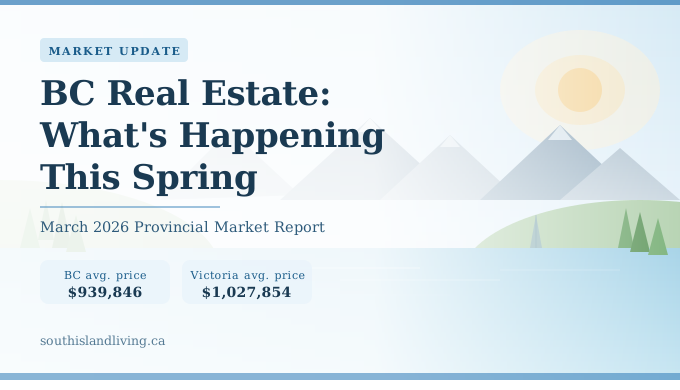
Across BC, 5,766 residential sales were recorded on MLS® systems in March 2026 — down 3.6% from March 2025. The average residential price province-wide came in at $939,846, a 2% dip from the $959,236 recorded a year ago. Total sales dollar volume reached $4.21 billion, down 5.6% year-over-year, and BC sales are sitting about 34.5% below the ten-year average for March.

BCREA Chief Economist Brendon Ogmundson put it plainly: "Global conflict leading to rising mortgage rates paired with a sluggish economy are presenting a challenge for a housing market recovery. Improved affordability and pent-up demand should translate to an acceleration of activity, though the market will need a period of relative calm for households to build confidence."

Year-to-date through the end of March, provincial sales dollar volume is down 13% to $12.7 billion, with unit sales off 11% at 13,595 and the average price down 2.2% to $933,859 compared to the same stretch in 2025.

How Vancouver Island and Victoria Compare

Here's where it gets interesting for South Island residents.

The Vancouver Island board — which covers communities from the Cowichan Valley north — recorded 606 sales in March at an average price of $769,396, down just 1.3% in price year-over-year and essentially flat on sales volume (-0.7%). Active listings did tick up 3.5%, giving buyers a bit more to work with than they've had in recent years.

Victoria, our own backyard, actually bucked the provincial trend on price. The Victoria board recorded 550 sales at an average price of $1,027,854 — a 4% increase over March 2025. Sales-to-active listings came in at 21.6%, which still reflects a reasonably balanced-to-seller leaning market despite slower overall activity. Active listings grew 7.4%, which signals a gradual normalization of inventory.

What This Means If You're Thinking About a Move

For buyers: more inventory and modest price softening in many BC markets — including parts of our region — means there's room to make thoughtful decisions without the frantic pace of previous years. That's not a bad thing.

For sellers: the Victoria market, in particular, is holding its value better than most of the province. Pricing your home accurately and presenting it well still matters enormously, but the fundamentals here remain solid compared to many other BC communities.

For those on the fence: the BCREA's own economist is pointing to pent-up demand and improved affordability as forces that should drive a recovery — once there's a stretch of economic calm to give households the confidence to act.

Life on Southern Vancouver Island doesn't change with every monthly report. The reasons people want to be here — the lifestyle, the communities, the geography — are durable. But understanding the market environment helps you make smarter decisions when the time comes.

Curious what the numbers mean for your specific neighbourhood or situation? Reach out — I'm always happy to chat.

Mike Doughty | RE/MAX Camosun 📞 778-400-0475 | ✉️ mike@mikedoughty.ca | 🌐 www.southislandliving.ca

Read

New Listing Now Available in La Goldstream, Langford

Just listed at 21 2911 Sooke Lake Rd in Langford. See details here

Affordable living in the Sooke Lake Modular Home Co-op! This 2 bed, 1 bath single-wide offers incredible value with low monthly fees and taxes, all within a secure, community-focused setting. Inside, you’ll find a bright, functional layout with in-unit laundry, a newer hot water tank and fridge, and efficient heating with a pellet stove. Step outside to your private back deck—perfect for morning coffee or relaxing after a day outdoors. The property also includes a small yard, storage shed, and a rare bonus: an attached shop/garage, ideal for hobbies, storage, or a workspace. Located between Goldstream Provincial Park and Sooke Hills Wilderness Regional Park, you’ll enjoy endless hiking and biking trails, while still being just minutes from all the shopping, dining, and everyday amenities of Langford. An excellent opportunity for first-time buyers, downsizers, or anyone looking for an affordable entry into the South Island market without sacrificing lifestyle.

Read

Co-Op Housing in BC: What Buyers and Sellers Need to Know

Thinking about buying or selling co-op housing on Vancouver Island or in Greater Victoria? Here's everything you need to know about how co-ops work in BC — from share ownership to financing quirks and what to expect from the process.

If you've been browsing listings around Greater Victoria or the Westshore and stumbled across a co-op property, you might have done a double-take. Co-ops look a lot like stratas on the surface — shared buildings, common areas, monthly fees — but they work quite differently under the hood. And here on Vancouver Island, where affordability is always top of mind, they're worth understanding.

Whether you're a buyer exploring every option or a current co-op resident thinking about your next move, here's a straight-talking breakdown of what co-op housing actually is, how it works in BC, and what to watch out for.

What Is a Co-Op, Exactly?

A housing co-operative — or co-op — is a form of collective ownership. Rather than buying a unit outright (like you would with a condo), you purchase shares in a nonprofit corporation that owns the building and land. Those shares give you the right to occupy a specific unit and participate in decision-making about how the property is run.

In other words: you're a shareholder and a resident at the same time. You don't hold a title to your unit — you hold shares. It's a subtle but significant legal distinction that affects everything from how you finance the purchase to how you eventually sell.

Co-ops can take many forms: apartment-style buildings, townhouses, duplexes, mobile homes and even clusters of smaller homes. In BC, the model has historically been associated with affordable, community-focused housing, and the province has a well-established co-op sector. British Columbia has over 270 co-ops throughout the province, totalling more than 15,700 units, overseen by the Co-operative Housing Federation of BC (CHF BC). WOWA The majority of housing co-ops in BC are located in Metro Vancouver and on Vancouver Island. CHF BC

How Co-Op Housing Works

When you join a co-op, you're becoming part of a democratically run community. The structure typically looks like this:

A board of directors, elected by shareholders, makes decisions guided by the co-op's bylaws. A co-op association manages the collective finances — collecting monthly fees that cover property taxes, building maintenance, utilities, and any underlying mortgage on the property. As a shareholder, you contribute to these shared expenses and have a voice in how the co-op operates.

Your monthly housing charge covers more than just your unit — it's your share of running the whole building or property. Some co-ops also hire a property management company to handle day-to-day issues.

Co-Op vs. Strata: What's the Difference?

This is where buyers often get tripped up. Both co-ops and stratas involve shared buildings and communal responsibilities, but the ownership structure is fundamentally different.

With a strata, you own your individual unit. You hold the deed. Any appreciation in the value of your unit belongs to you, and you generally have more freedom to renovate, rent, or sell on your own timeline.

With a co-op, you own shares in the corporation that owns the property. You receive stock instead of a title as you would with a traditional home purchase. rocketmortgage Your ability to renovate, sublet, or sell may be subject to co-op bylaws and board approval. That said, co-ops often come with lower purchase prices — a meaningful advantage in high-cost markets.

Buying a Co-Op in BC: What to Expect

If you're considering buying into a co-op, the process differs from a typical real estate transaction in a few key ways.

The application and approval process. Most co-ops require prospective buyers to apply and be approved by the board. Approval is based on your financial stability and sometimes on your compatibility with the co-op's community and values. Co-op boards have the right to approve or reject candidates, which is different from conventional real estate transactions where sellers cannot usually reject a financially qualified buyer. Be prepared to submit financial documentation and, in some cases, character references or an interview.

Financing can be more complex. This is probably the biggest hurdle for buyers. Because you're purchasing shares rather than real property, traditional mortgage financing doesn't always apply. Some lenders are hesitant to provide loans for co-op shares, so it may take time to find a suitable mortgage provider. Interest rates might be higher, and the down payment requirements might also be more substantial compared to other types of properties. Talk to a mortgage broker who has experience with co-op transactions in BC before you get too far into the process.

Review the documents carefully. Once you've found a co-op you're interested in, due diligence is critical. You should inspect the physical condition of the unit and understand the financial health of the co-op. Obtain and review the co-op's financial statements, bylaws, and any other relevant documents. The bylaws will tell you what you can and can't do with your unit — including rules around subletting, renovations, and resale.

Sign a shareholder agreement. Upon acceptance, you'll enter into a shareholder agreement that outlines your rights and responsibilities as a co-op member. This document governs much of your day-to-day life in the co-op, so it's worth reading closely (and ideally having a real estate lawyer review it).

Selling a Co-Op: What You Should Know

Selling a co-op share isn't the same as listing a condo or home on MLS. There are a few things to keep in mind.

The co-op may have resale restrictions. Some co-ops have bylaws that limit how shares can be sold, who can buy them, and what price can be charged. In some cases, the co-op itself has right of first refusal — meaning it can buy the shares back before you sell to an outside buyer.

Resale value can be tied to the co-op's financial health. Resale prices can be influenced by the co-op's financial health and its rules on selling. If the building has deferred maintenance, a large underlying mortgage, or ongoing financial challenges, that can affect what your shares are worth.

New buyers still need board approval. When you sell, your buyer will need to go through the same application and approval process you did. This can add time to a transaction and, in some cases, create complications if a prospective buyer doesn't meet the board's criteria.

Working with a REALTOR® matters. Because co-op transactions involve layers of legal and financial complexity that don't exist in typical home sales, having a REALTOR® and a lawyer who are familiar with co-ops in BC is genuinely important — not just a nice-to-have.

The Pros and Cons of Co-Op Living

Like any housing type, co-ops have real advantages and real trade-offs. Here's a balanced look:

Why co-ops can be a great fit: Lower purchase prices compared to equivalent condos in many markets. A built-in sense of community and shared responsibility. Reduced individual maintenance burden. Potential tax benefits in some circumstances (consult a tax professional). Long-term stability — many co-ops in BC have been well-managed for decades.

Where co-ops require more thought: The application and approval process adds time and uncertainty. Financing is more complex and options are more limited than with traditional purchases. Bylaws may restrict your ability to renovate, sublet, or sell freely. Resale pools can be smaller, which may affect how quickly you can move if life changes.

Co-Ops on Vancouver Island: A Local Perspective

Co-op housing has a meaningful presence on Vancouver Island, particularly in Greater Victoria. For buyers priced out of the freehold market — or those who genuinely value community-oriented living — co-ops offer a legitimate pathway to putting down roots here.

If you're curious about what's available, the Co-operative Housing Federation of BC maintains a searchable directory of member co-ops across the province. Individual co-ops manage their own waitlists and application processes, so the best first step is reaching out directly to co-ops in the area you're interested in.

Whether a co-op is right for you depends on your lifestyle, financial situation, and long-term goals. But it's absolutely worth understanding — especially in a market like Greater Victoria, where every option matters.

Thinking About Buying or Selling a Co-Op?

Co-ops are a niche but real part of the Southern Vancouver Island real estate landscape, and navigating them well means working with someone who knows the local market and the nuances involved.

If you have questions about co-op properties — or any type of housing on the Island — I'm always happy to have a conversation. Reach out anytime at mike@mikedoughty.ca or 778-400-0475.


Mike Doughty is a REALTOR® with RE/MAX Camosun serving Greater Victoria, the Westshore, Sooke, and the Cowichan Valley. This post is for informational purposes only and does not constitute legal or financial advice. Always consult qualified professionals when making real estate decisions.
Read

Spring Is Showing Up: Greater Victoria's March 2026 Real Estate Market

The Greater Victoria real estate market is following a familiar spring script in March 2026 — more listings, more sales, and a balanced market that's giving buyers and sellers alike room to breathe. Here's what the numbers say.

There's something reassuring about a market that behaves the way it's supposed to.

After a quieter winter, Greater Victoria's real estate scene is waking up the way it typically does this time of year — steadily, and without drama. March 2026 brought more listings to market, more sales through the door, and a tone that feels, for the first time in a while, genuinely balanced.

That's not spin. That's what the data shows.

The Numbers at a Glance

579 properties changed hands across the Victoria Real Estate Board region in March 2026. That's 24.5 per cent more than February — a meaningful jump that signals the seasonal momentum buyers and sellers tend to feel this time of year. Year-over-year, sales dipped 5.5 per cent compared to March 2025, but that context matters less than the direction of travel, which is clearly upward as we head into spring.

Single family home sales came in at 285 — down just 2.4 per cent from last March, which is about as close to flat as it gets. Condo sales were softer at 164 units, off 18.8 per cent year-over-year, though the monthly jump from February tells a more encouraging story for that segment.

On the supply side, there were 3,261 active listings at the end of March — up 12.3 per cent from February and 7.9 per cent from a year ago. More choice for buyers, and a market that isn't putting sellers under the gun the way it once did.

What Prices Are Doing

The MLS® Home Price Index — a more reliable measure of price trends than averages or medians — shows values holding relatively steady.

The benchmark price for a single family home in the Victoria Core sits at $1,330,200 in March 2026. That's down 1.1 per cent from a year ago, but up from February's $1,307,400 — a sign that spring is nudging values in the right direction month-over-month.

For condominiums in the Victoria Core, the benchmark lands at $553,800. Down 0.8 per cent year-over-year, up from $545,600 last month.

Across the broader VREB region, single family benchmark prices range from $1,027,900 on the Westshore to $1,250,900 on the Peninsula. Townhomes in the Core are benchmarked at $848,500 — a format that continues to offer a meaningful entry point for buyers who want more space without the full single-family price tag.

A Balanced Market — And Why That's Actually Good News

Victoria's sales-to-active-listings ratio has been sitting in the balanced range — that 17–28% band where neither buyers nor sellers hold all the cards. According to BCREA's regression analysis, it's the zone where prices face relatively little pressure in either direction.

For buyers, that means time to think, time to do due diligence, and fewer bidding war situations forcing rushed decisions. For sellers, it means well-priced, well-presented homes are still moving — they just need the right strategy going in.

VREB Chair Fergus Kyne put it well: "Every listing is unique in our market. Greater Victoria is a relatively small area which consists of many micro markets with varying conditions and demand."

That's something locals already know. What sells quickly in Langford might sit longer in Oak Bay, and vice versa. What flies in one price range drags in another. The market isn't one thing — it's a collection of neighbourhoods, property types, and buyer pools, each with its own rhythm.

Looking Ahead

Spring is traditionally the strongest season for real estate on the South Island, with activity typically building toward a peak in May or June. With inventory climbing and buyer interest picking up, the pieces are in place for a solid couple of months ahead.

Whether you're thinking about listing, buying, or just keeping an eye on things, it's a good time to get current on what's actually happening in your corner of Greater Victoria.

Read

Another property successfully sold at 213 2829 Peatt Rd in Langford

This property at 213 2829 Peatt Rd in Langford sold on Mar 31, 2026. See details here

NEW PRICE! STEPS TO VIBRANT LANFORD CITY CENTRE! This spacious & private 1-bedroom plus DEN condo is a perfect starter or downsizer close to everything to walk to! Featuring a large open floor plan, a nice kitchen with eating bar, in-unit laundry, and a huge 420 sqft deck perfect for patio furniture, BBQ’s and summer entertaining. The Valentine is a well-maintained strata with parking & hot water included, pets are welcome, and units are rentable, making this a great place to call home. All located just steps away from downtown Langford, shopping, newly constructed UVIC & Royal Roads facility, restaurants, bus routes, and much more. BONUS NEW flooring just installed! A great community and a very convenient neighborhood to enjoy. Book your appt to view soon.

Read

You Might Qualify for Up to $50,000 Back on Your New Home — Even If You've Owned Before

First-time buyer on Vancouver Island? Canada's new GST rebate on new homes could save you up to $50,000 — and you might qualify even if you've owned before. Here's what you need to know.

If you've been sitting on the sidelines of the housing market thinking homeownership is out of reach, this one's worth reading closely. The federal government has passed a new GST rebate that could put up to $50,000 back in your pocket when you buy or build a new home — and the eligibility rules are more forgiving than most people realize.

This is real, it's now law, and it applies right here on Southern Vancouver Island.

What Is This Rebate, Exactly?

The First-Time Home Buyers' GST/HST Rebate (FTHB rebate) eliminates or reduces the GST on newly built homes. Eligible buyers can recover up to 100% of the GST paid on new homes up to $1.5 million, with a maximum rebate of $50,000. Bcrealestatelawyers For a $900,000 new build — very much in the range of what you'll find in places like Langford, Colwood, or the Cowichan Valley — that's $45,000 back. That's a down payment. That's a year's worth of mortgage payments. That's real money.

To be eligible, your agreement of purchase and sale must have been entered into on or after March 20, 2025. Clementhomes If you signed after that date, you may already qualify — even if you haven't closed yet.

The "Five-Year Window" Rule — More People Qualify Than You Think

Here's where it gets interesting. You don't have to be a lifetime renter to qualify. To be considered a first-time home buyer under this program, you simply must not have lived in a home that you or your spouse or common-law partner owned as your primary place of residence at any time in the current calendar year or the previous four calendar years. Canada.ca

In plain terms: if neither you nor your partner has lived in a home you owned since the start of 2021 (for a 2025 purchase), or since the start of 2022 (for a 2026 purchase), you likely qualify.

Sold your home a few years ago and have been renting since? You may be back in the game. Went through a separation? Relocated and rented? Life happens — and the rules account for it.

Can a Family Member Be on Title With You?

Yes—and this is a detail many people don't know about. Where two or more individuals are on title, the rebate is available as long as the home will be used as the primary place of residence of any of the individuals, or a relation of any of them, and the other eligibility conditions are met by at least one person. Canada.ca

So if a parent or sibling is going on title to help you qualify for a mortgage, that doesn't automatically disqualify you from the rebate — provided you, as the first-time buyer, meet all the conditions and are using the home as your primary residence. This is a meaningful detail for families helping younger buyers get into the market.

A few important notes on this:

  • All co-owners must be individuals — if a corporation is a co-owner, the home is not eligible. Bcrealestatelawyers

  • The rebate can only be claimed once per eligible individual.

  • If your spouse or partner has previously claimed this rebate, you are not eligible. PwC Canada

How Much Could You Save?

The rebate works on a sliding scale:

  • Homes up to $1 million: Full rebate — up to $50,000

  • Homes between $1M and $1.5M: Partial rebate, scaled proportionally (e.g., a $1.25M home = roughly $25,000 back)

  • Homes over $1.5M: No rebate under this program

How Does It Actually Get Applied?

For new homes bought directly from a builder, the rebate may be applied at closing — you pay the net amount with the rebate deducted, and the builder claims the difference from the government. Pbo-dpb If you're building your own home, you pay the GST upfront and then apply directly with the CRA using your CRA account or by mailing in the appropriate form once construction is substantially complete. MNP

What Qualifies as a "New Home"?

This rebate applies to:

  • New homes purchased from a builder (condos, townhomes, detached homes)

  • Substantially renovated homes (where 90% or more of the interior has been replaced)

  • Owner-built homes where construction started on or after March 20, 2025

Resale homes don't qualify — there's no GST on a resale property, so there's nothing to rebate.

The Bottom Line for Vancouver Island Buyers

Southern Vancouver Island has seen a surge in new construction — particularly in Langford, Colwood, the Westshore, and communities like Duncan and Lake Cowichan in the Cowichan Valley. If you're considering a new build in any of these areas and you meet the eligibility criteria, this rebate is a legitimate, significant financial advantage.

Talk to your REALTOR® and your accountant before you sign anything, but don't let a lack of awareness cost you thousands. The window is open — agreements signed before 2031 can qualify.

Wondering if a new home on the South Island could be the right move for you? Reach out — happy to point you in the right direction.

Read

Bank of Canada Holds Rate at 2.25% — What It Means for Southern Vancouver Island Homebuyers and Sellers

The Bank of Canada held its overnight rate at 2.25% on March 18, 2026. Here's what the decision means for homebuyers and sellers on Southern Vancouver Island — and what to watch for next.

March 18, 2026

This morning the Bank of Canada did exactly what most economists expected: it held its overnight policy rate steady at 2.25%. It's the second hold of the year, following an identical decision in January, and it leaves borrowing costs essentially unchanged since last fall.

On the surface, a hold sounds like a non-event. But the story behind this decision is more complicated — and worth understanding if you're thinking about buying or selling a home on Southern Vancouver Island in the months ahead.


What the Bank of Canada Actually Said

The Bank held its target for the overnight rate at 2.25%, with the Bank Rate at 2.5% and the deposit rate at 2.20%. Bank of Canada

In its statement, the Bank acknowledged that the Canadian economy continues to adjust to U.S. tariffs and trade uncertainty, but flagged that recent data suggest near-term economic growth will be weaker than anticipated in January, with the labour market remaining soft — employment gains from Q4 2025 were largely reversed in the first two months of 2026, and the unemployment rate climbed to 6.7% in February. BNN Bloomberg

On inflation, the picture is actually pretty encouraging at first glance. CPI inflation eased to 1.8% in February, down from 2.3% in January, and core inflation measures have also come down and are close to 2%. Bank of Canada

So why the hold, rather than a cut? One word: energy. The sharp increase in global energy prices has led to higher gasoline prices, and this will push total inflation higher in the coming months. Bank of Canada The conflict in the Middle East has added a layer of uncertainty the Bank wasn't willing to look past just yet.


The Rate Cut Case — And Why It's on Hold

Here's the honest picture: if it weren't for elevated geopolitical risk and rising oil prices, there's a solid argument that rates should already be moving lower. Core inflation has been decelerating for months. Economic growth is soft. Employment is weak. Under normal conditions, that's a textbook case for cuts.

Instead, the Bank finds itself in a wait-and-see position, trying to separate a potentially temporary energy price spike from a more persistent inflationary shift. Most estimates suggest that a prolonged period of high oil prices could add roughly 1% to consumer inflation — potentially pushing CPI back above 3%. That's a meaningful risk the Bank has to weigh against an already-sluggish economy.

TD Economist Maria Solovieva summed it up well: "When inflation is close to the central bank's target, there is no strong reason to change course. GDP growth is below target, but it's not enough for the Bank to move its interest rate, either." TD

The next rate announcement is scheduled for April 29, 2026, at which point the Bank will also release its quarterly Monetary Policy Report — giving us a fuller picture of where things are headed.


What This Means for the Local Market

For buyers and sellers here in Greater Victoria, the Westshore, Sooke, and the Cowichan Valley, today's hold means a few things practically:

If you're a buyer: Fixed mortgage rates have been relatively stable, and variable rates remain tied to the overnight rate at 2.25%. Lenders aren't pricing in near-term cuts the way they were a few months ago, so the rate environment you're shopping in right now is likely close to what you'll see through spring. It's not a bad time to get pre-approved and lock in certainty.

If you're a seller: Buyer purchasing power hasn't meaningfully changed with today's decision. Demand in our local market continues to be driven by lifestyle factors — the Island's quality of life, remote work flexibility, and relative affordability compared to Metro Vancouver — more than interest rate movements alone.

The bigger wildcard: Energy prices and their downstream effects on inflation will be the thing to watch. If oil stabilizes, the Bank may have room to cut in the summer or fall. If prices stay elevated and push CPI higher, cuts could be pushed further out — or taken off the table entirely for 2026.


The Bottom Line

Today's hold was the cautious, sensible call given genuine uncertainty in the global economy. The Bank isn't slamming the brakes — it's just keeping its foot off the gas until it has a clearer read on where inflation is actually heading.

For most people thinking about real estate on Southern Vancouver Island, this isn't a reason to pause or panic. The fundamentals of our local market — limited supply, consistent demand, and strong community appeal — don't change based on a single rate announcement.

If you're weighing a move and want to talk through what today's news means for your specific situation, I'm happy to chat. 778-400-0475 mike@mikedoughty.ca


Mike Doughty is a REALTOR® with RE/MAX Camosun, serving Greater Victoria, the Westshore, Sooke, and the Cowichan Valley. The views expressed here are for informational purposes and do not constitute financial or mortgage advice.

Read

Canadian Inflation Drops to 1.8% in February — But Don't Get Too Comfortable

Canadian inflation cooled to 1.8% year-over-year in February 2026, with BC coming in at 1.7%. Here's what the latest CPI data means for your wallet — and what's likely coming next.

Published: March 16, 2026 | southislandliving.ca


If you've been keeping an eye on the cost of living lately, February's inflation numbers offer a bit of good news — at least on the surface. Statistics Canada released the latest Consumer Price Index (CPI) data this morning, and the headline number looks encouraging. But dig a little deeper, and the picture gets more complicated.

Here's what you need to know.


Headline Inflation Dips Below 2% — Here's Why

The Canadian CPI rose 1.8% year-over-year in February, down from a 2.3% increase in January. On a seasonally adjusted monthly basis, prices were up just 0.1%. Statistics Canada

That's a meaningful drop, but context matters. The slowdown in year-over-year inflation was largely driven by a base-year effect: back in February 2025, prices jumped when the federal GST/HST tax holiday ended partway through the month. That monthly spike in early 2025 fell out of the 12-month comparison this year, artificially pulling the headline number lower. Statistics Canada

In short — inflation didn't necessarily slow down because prices stopped rising. It slowed partly because prices spiked at this time last year, making year-over-year comparisons look more favourable.

Restaurant meals were the biggest beneficiary of this base-year effect, with annual inflation in that category cooling to 7.8% in February from 12.3% in January. BNN Bloomberg


What's Actually Getting More Expensive

Even with the headline number trending down, some categories are still putting real pressure on household budgets.

Food remains a sore spot. Nationally, food prices rose 5.4% year-over-year in February — a significant improvement from the 7.3% pace recorded in January, but still well above overall inflation. Grocery prices rose 4.1% annually in February, moderating from 4.8% in January, with fresh and frozen beef cooling to a 13.9% annual increase — nearly five percentage points lower than the month before. BNN Bloomberg

In BC specifically (see the chart above), food was up 4.5% year-over-year in February, down from 6.1% in January — a welcome improvement, but still a noticeable hit at the checkout counter.

Health and personal care also continues to climb, with BC seeing a 4.4% year-over-year increase in February (down slightly from 5.3% in January).

On the brighter side, gasoline and transportation costs are providing meaningful relief. BC gasoline prices fell 11.6% year-over-year in February, and transportation overall dropped 1.0%. Cellular service prices also fell on a month-over-month basis, helping pull the overall rate lower. Narcity

Shelter costs in BC rose 1.5% year-over-year — actually a slight improvement from 1.8% in January, and well below the peak pressure we saw in 2022–2023.


How Does BC Stack Up?

British Columbia came in slightly below the national average. Consumer prices in BC rose 1.7% year-over-year in February, down 0.3 percentage points from January. Provinces with HST — like Ontario and those in Atlantic Canada — were more heavily impacted by the base-year effect from the 2025 tax break, as PST was not included in the relief in provinces like BC where federal and provincial sales taxes aren't combined. Statistics Canada

That means BC's disinflation is somewhat more "real" than what we're seeing in some other parts of the country — a sign that underlying price pressures here are genuinely easing.


Core Inflation: The Number That Really Matters

Beyond the headline figure, economists and the Bank of Canada pay close attention to "core" inflation measures, which strip out volatile components like energy and food to give a cleaner read on underlying price trends.

The two Bank of Canada preferred measures — CPI-median and CPI-trim — both fell to 2.3% year-over-year in February, each moving closer to the Bank's 2% target. CPI-common dropped from 2.7% to 2.4%, while CPI-median and CPI-trim each fell to 2.3%, the lowest levels in some time. CBC News

Perhaps most telling: 3-month annualized core inflation has cooled to just over 1% — levels not seen since May 2020. That's a significant signal that underlying price momentum has genuinely slowed.


What This Means for the Bank of Canada

All eyes are now on the Bank of Canada's interest rate decision this Wednesday. On the surface, cooling inflation and a weakening labour market would normally make a strong case for another rate cut.

As BMO chief economist Douglas Porter noted, with most measures of core inflation near the 2% target, policymakers can more readily "look through" any oil-driven spike that may be coming in headline inflation over the next few months — particularly given that employment was already weakening before recent global developments, and with the uncertain fate of Canada's trade relationship with the U.S. still unresolved. CBC News

However, there's a significant wildcard: the US-Iran conflict began on the last day of February, and its full impact on energy prices won't show up until next month's inflation report. Some economists expect gas prices could spike as much as 15%, which would drive headline inflation back toward 3% in the coming months. CBC News

Given that backdrop — strong core disinflation on one hand, and an emerging oil price shock on the other — the Bank of Canada is widely expected to hold rates steady on Wednesday as it assesses how deep and how lasting the supply disruption from rising oil prices will be.


The Bottom Line for Vancouver Island Households

February's inflation data is genuinely good news in several ways. Core prices are cooling, shelter costs are moderating, gasoline has been providing relief at the pump, and food inflation — while still elevated — is moving in the right direction.

But there's no guarantee this trend continues. The coming months are likely to bring renewed upward pressure on energy prices, which will filter through to transportation, goods, and eventually food. The Bank of Canada has a delicate balancing act ahead of it.

For Island families, the practical takeaway is this: the worst of the post-pandemic inflation surge is firmly behind us, and conditions are genuinely more stable than they were two or three years ago. Whether that stability holds through 2026 will depend on factors largely outside Canada's control.

Stay tuned — and as always, if you have questions about how economic conditions are affecting the Southern Vancouver Island real estate market, feel free to reach out.


Mike Doughty | RE/MAX Camosun 📞 778-400-0475 | ✉️ mike@mikedoughty.ca | 🌐 www.southislandliving.ca

Read

What February's Provincial Real Estate Numbers Mean for South Island Buyers and Sellers

February 2026 BC real estate stats show a slower market province-wide, but Southern Vancouver Island and Greater Victoria are holding steady. Here's what the numbers mean for buyers and sellers on the South Island.

Market Update | March 2026

If you've been keeping an eye on BC's housing market, you've probably noticed the headlines aren't exactly cheerful. The province-wide numbers for February 2026 tell a story of a market in a bit of a holding pattern — but what's happening at the provincial level and what's happening here on Southern Vancouver Island are two different conversations worth having.

Let's dig in.

The Big Picture: BC's Market Is Quiet

The British Columbia Real Estate Association (BCREA) released its February 2026 statistics this week, and the headline numbers reflect a market that's still finding its footing. Across the province, residential sales were down nearly 10% compared to February 2025, with the average home price settling at $932,243 — a drop of about 3% year-over-year. Total sales volume province-wide came in at $4.21 billion, down 12.3% from the same month last year. BC unit sales were also sitting roughly 33% below the 10-year average for February — a notable gap that speaks to how much buyer hesitation has shaped this market cycle.

BCREA Chief Economist Brendon Ogmundson acknowledged the sluggishness but pointed to a potential upside: improved affordability conditions in many regions, combined with stable interest rates, could be the catalyst that starts pulling more buyers off the sidelines as spring approaches.

Year-to-date, the provincial numbers are even more sobering — residential sales volume down 17.8% and unit sales off 15.8% compared to the first two months of 2025.

But — and this is important — the South Island market is telling a more nuanced story.

The South Island: Holding Its Own

When you break the provincial data down by board, Greater Victoria and Vancouver Island both show year-over-year softness, but they're outperforming some of the harder-hit markets in the province considerably.

The Victoria Real Estate Board (VREB) reported 465 properties sold across the region in February — down 11.9% from February 2025, but a significant 37% jump from January's pace. That month-over-month acceleration is an encouraging sign that buyers are starting to re-engage as we move into spring.

Single family home sales came in at 206 units, down 12% year-over-year, while condo sales saw the biggest dip — 154 units sold, off nearly 20% from a year ago. The condo segment has been the softer part of the market for a while now, and that trend is continuing.

On the Vancouver Island board (which covers areas like the Cowichan Valley and up-island), 443 units sold in February at an average price of $719,111 — down just 1.9% from a year ago. That modest price dip, combined with a sales-to-active-listings ratio of 15.2%, tells us the Island market, while cooler, remains more stable than many parts of the province.

What About Prices?

The MLS® Home Price Index benchmark for a single family home in the Victoria Core came in at $1,307,400 in February — down less than 1% from a year ago, and actually up from January's benchmark of $1,265,500. That's a meaningful month-over-month recovery that suggests the floor is holding.

Condo benchmarks in the Victoria Core landed at $545,600, also down less than 1% year-over-year. Again, relative stability compared to what's happening in many other parts of BC.

Compared to the broader BC average of $932,243, the Victoria board's average of just over $1 million still reflects the premium that comes with living in one of Canada's most desirable regions — but that premium has narrowed slightly, which is genuinely good news for buyers who've been waiting for a better entry point.

What This Means If You're a Buyer

This is arguably the most buyer-friendly market Southern Vancouver Island has seen in a few years. Inventory is up — there were 2,903 active listings across the VREB region at the end of February, a 10.4% increase from a year ago. More choice, more time to make decisions, and more room to negotiate conditions into your offers. If you've been watching from the sidelines waiting for the right moment, spring 2026 is worth a serious look.

What This Means If You're a Seller

The market is balanced — not crashed, not booming. Homes that are priced right and presented well are still moving. The key word there is "priced right." With more inventory available, buyers have options and they know it. Overpriced listings are sitting longer, and the market is rewarding sellers who are realistic about value from day one. If you're thinking about listing this spring, connecting with a local REALTOR® who knows your specific neighbourhood — not just the broad market averages — is more important than ever.

The Bottom Line

BC's housing market is navigating a challenging stretch, no question. But Southern Vancouver Island continues to demonstrate the resilience that makes this region stand out. Prices are stable, inventory is healthy, and the month-over-month momentum heading into spring is encouraging. This isn't a market to fear — it's a market to understand.

If you have questions about what these numbers mean for your specific situation on the South Island, feel free to reach out. I'm always happy to talk real estate.

Mike Doughty | REALTOR® | RE/MAX Camosun 778-400-0475 | mike@mikedoughty.ca | southislandliving.ca

Read

Open House. Open House on Saturday, March 7, 2026 11:00AM - 12:30PM

You’re invited to an Open House at 2121 Charters Rd in Sooke. See details here

Open House on Saturday, March 7, 2026 11:00AM - 12:30PM

One of the best-positioned homes in the Grasslands townhome complex, this bright corner/end-unit backs and sides onto forested greenspace, offering excellent privacy and a peaceful West Coast feel. The open-concept main floor features quartz countertops, stainless steel appliances, a spacious dining area, bright living room, and a convenient 2-piece powder room. Step outside to the covered patio and fully fenced backyard with a gas BBQ hookup. Upstairs offers three bedrooms, two full bathrooms, and laundry. The primary bedroom includes a walk-in closet and ensuite with quartz countertops and a walk-in shower. Additional features include hot water on demand, a single-car garage, and driveway parking. Ideally located on Charters Road within walking distance to schools, parks, golf, transit, shopping, restaurants, oceanfront trails, and Sooke’s town core.

Read

Open House. Open House on Saturday, March 7, 2026 1:00PM - 2:30PM

You’re invited to an Open House at 2042 Terrott St in Sooke. See details here

Open House on Saturday, March 7, 2026 1:00PM - 2:30PM

Well-kept Sooke 1/2 duplex with harbour views, nearby water access, and no hefty strata fees. Experience West Coast living in this 2020-built home, just steps to the shoreline and minutes from Sooke’s town core. A great mix of nature, convenience, and easy-care living. Bright, open plan suited for daily life and hosting. Unwind in the living room while friends take in Sooke Harbour views from one of two sunny south-facing decks. Upstairs features two bedrooms, including a comfortable primary with ensuite, plus a second full bath. Downstairs provides a spacious third bedroom or flex space with its own bathroom—perfect for visitors, teens, extended family, or a peaceful home office. Quick access to the highway, shopping, cafés, schools, and the Westshore commute. When it’s time to relax, stroll the waterfront or catch those classic Sooke sunsets from home. Quality construction and an excellent setting make this a smart choice for buyers wanting lifestyle and value.

Read
Categories:   Co Colwood Lake, Colwood Real Estate | Co Olympic View, Colwood Real Estate | Co Royal Bay, Colwood Real Estate | Co Triangle, Colwood Real Estate | CS Tanner, Central Saanich Real Estate | CS Turgoose, Central Saanich Real Estate | Du Chemainus, Duncan Real Estate | Du Crofton, Duncan Real Estate | Du East Duncan, Duncan Real Estate | Du Ladysmith, Duncan Real Estate | Du Lake Cowichan, Duncan Real Estate | Du West Duncan, Duncan Real Estate | Es Esquimalt, Esquimalt Real Estate | Es Gorge Vale, Esquimalt Real Estate | Es Kinsmen Park, Esquimalt Real Estate | La Atkins, Langford Real Estate | La Bear Mountain, Langford Real Estate | La Glen Lake, Langford Real Estate | La Goldstream, Langford Real Estate | La Happy Valley, Langford Real Estate | La Langford Proper, Langford Real Estate | La Mill Hill, Langford Real Estate | La Olympic View, Langford Real Estate | La Westhills, Langford Real Estate | Me Metchosin, Metchosin Real Estate | ML Cobble Hill, Malahat & Area Real Estate | ML Malahat Proper, Malahat & Area Real Estate | ML Mill Bay, Malahat & Area Real Estate | ML Shawnigan, Malahat & Area Real Estate | Na Departure Bay, Nanaimo Real Estate | NS Deep Cove, North Saanich Real Estate | PA Port Alberni, Port Alberni Real Estate | SE Quadra, Saanich East Real Estate | Sk Broomhill, Sooke Real Estate | Sk Otter Point, Sooke Real Estate | Sk Sooke Vill Core, Sooke Real Estate | SW Gorge, Saanich West Real Estate | Vi Central Park, Victoria Real Estate | Vi Downtown, Victoria Real Estate | Vi Fernwood, Victoria Real Estate | Vi James Bay, Victoria Real Estate | Vi Jubilee, Victoria Real Estate | VR Glentana, View Royal Real Estate | VR View Royal, View Royal Real Estate
MLS® property information is provided under copyright© by the Vancouver Island Real Estate Board and Victoria Real Estate Board. The information is from sources deemed reliable, but should not be relied upon without independent verification.