Provincial stats paint a cautious picture — but here on Southern Vancouver Island, the story has some important nuance.
The British Columbia Real Estate Association released its March 2026 provincial market numbers this week, and if you've been following along with the broader economic headlines — tariff uncertainty, global trade tensions, mortgage rate pressure — the data won't come as much of a surprise. But as always, provincial averages tell only part of the story. If you're living on, or thinking about moving to, Southern Vancouver Island, there's context worth understanding.
The Provincial Picture
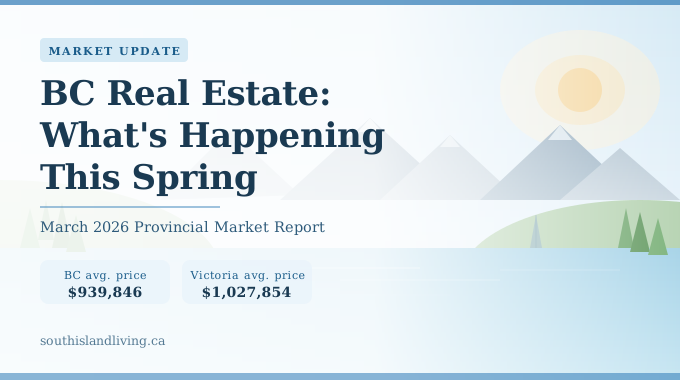
Across BC, 5,766 residential sales were recorded on MLS® systems in March 2026 — down 3.6% from March 2025. The average residential price province-wide came in at $939,846, a 2% dip from the $959,236 recorded a year ago. Total sales dollar volume reached $4.21 billion, down 5.6% year-over-year, and BC sales are sitting about 34.5% below the ten-year average for March.
BCREA Chief Economist Brendon Ogmundson put it plainly: "Global conflict leading to rising mortgage rates paired with a sluggish economy are presenting a challenge for a housing market recovery. Improved affordability and pent-up demand should translate to an acceleration of activity, though the market will need a period of relative calm for households to build confidence."
Year-to-date through the end of March, provincial sales dollar volume is down 13% to $12.7 billion, with unit sales off 11% at 13,595 and the average price down 2.2% to $933,859 compared to the same stretch in 2025.
How Vancouver Island and Victoria Compare
Here's where it gets interesting for South Island residents.
The Vancouver Island board — which covers communities from the Cowichan Valley north — recorded 606 sales in March at an average price of $769,396, down just 1.3% in price year-over-year and essentially flat on sales volume (-0.7%). Active listings did tick up 3.5%, giving buyers a bit more to work with than they've had in recent years.
Victoria, our own backyard, actually bucked the provincial trend on price. The Victoria board recorded 550 sales at an average price of $1,027,854 — a 4% increase over March 2025. Sales-to-active listings came in at 21.6%, which still reflects a reasonably balanced-to-seller leaning market despite slower overall activity. Active listings grew 7.4%, which signals a gradual normalization of inventory.
What This Means If You're Thinking About a Move
For buyers: more inventory and modest price softening in many BC markets — including parts of our region — means there's room to make thoughtful decisions without the frantic pace of previous years. That's not a bad thing.
For sellers: the Victoria market, in particular, is holding its value better than most of the province. Pricing your home accurately and presenting it well still matters enormously, but the fundamentals here remain solid compared to many other BC communities.
For those on the fence: the BCREA's own economist is pointing to pent-up demand and improved affordability as forces that should drive a recovery — once there's a stretch of economic calm to give households the confidence to act.
Life on Southern Vancouver Island doesn't change with every monthly report. The reasons people want to be here — the lifestyle, the communities, the geography — are durable. But understanding the market environment helps you make smarter decisions when the time comes.
Curious what the numbers mean for your specific neighbourhood or situation? Reach out — I'm always happy to chat.
Mike Doughty | RE/MAX Camosun 📞 778-400-0475 | ✉️ mike@mikedoughty.ca | 🌐 www.southislandliving.ca