The headlines sound cautious — but look closer and there are reasons for measured optimism, especially here on Southern Vancouver Island.
Spring is traditionally when the real estate market finds its rhythm on the South Island. More listings, more buyers out walking open houses, longer evenings that make every neighbourhood look its best. April 2026 brought all of that — and also a provincial data release from the BC Real Estate Association that's worth unpacking, because the context matters as much as the numbers.
The Provincial Picture
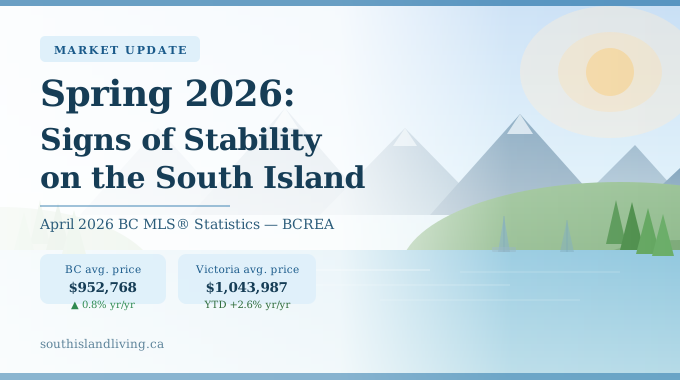
Across BC, 6,311 residential sales were recorded on MLS® systems in April 2026 — down 1.9% from April 2025 but notably higher than March's pace. The average residential price province-wide came in at $952,768, up 0.8% from $944,796 a year ago — a rare positive sign after months of year-over-year price softening. Total sales dollar volume reached $6.01 billion, down just 1.1% year over year. BC sales still sit about 25% below the ten-year average for April, reflecting how far activity has pulled back from the frenzied years of the early 2020s.
BCREA Chief Economist Brendon Ogmundson acknowledged the persistent headwinds: "Challenges in the local economy and labour market, combined with upward pressure on rates due to the ongoing oil supply shock, are continuing to suppress pent-up demand and weaken overall market activity." But he also offered something that's been in short supply lately — a note of cautious optimism: "Modest monthly gains (seasonally adjusted) in some regions hopefully depict the beginning of a broader stabilization in housing activity, underpinned by improved affordability conditions that should encourage prospective buyers to enter the market."
Year-to-date through the end of April, provincial sales dollar volume is down 9.5% to $18.7 billion. Unit sales are off 7.6% at 20,059, and the average price is down 2% to $932,492 compared to the same stretch last year.
Victoria and Vancouver Island: Still Holding Their Own
Here on the South Island, the numbers offer a more encouraging read than many other BC markets.
The Victoria Real Estate Board recorded 620 sales in April at an average price of $1,043,987. That's a 1.6% dip in price year-over-year — modest by any measure — while sales were actually up 2.3% compared to April 2025. Active listings grew 7% to 2,948, giving buyers meaningfully more choice than they had a year ago. The sales-to-active-listings ratio came in at 21%, placing Victoria firmly in balanced-to-seller territory.
Year-to-date, the Victoria board's average price is $1,030,030 — up 2.6% from the same period in 2025. That's one of the strongest year-to-date price performances in the province.
The broader Vancouver Island board — covering the Cowichan Valley, Nanaimo, and communities to the north — recorded 659 sales at an average price of $762,994, up 1.9% year-over-year. The sales count was down 13.4%, and active listings grew 6.6%, pointing to a more balanced market dynamic in those communities.
What the Oil Shock and Rate Environment Mean for Buyers
The BCREA's chart this month highlighted something worth understanding: upward pressure on fixed mortgage rates driven by the ongoing Iran conflict and the resulting oil supply disruption. Five-year Government of Canada bond yields — the benchmark that fixed mortgage rates follow — have climbed noticeably since the conflict began, adding cost to anyone locking in for the medium term.
This is one reason why variable-rate products have attracted renewed attention, with the Bank of Canada holding its overnight rate at 2.25% as of late April. For buyers watching their qualifying numbers closely, the choice of mortgage product is more meaningful than usual right now. A conversation with a mortgage professional before you start seriously shopping is time well spent.
The Takeaway for South Island Residents
The market here isn't in freefall — far from it. Victoria's year-to-date price appreciation is among the best in BC, and the sales-to-active ratio suggests demand is real, even if it's measured. More inventory means buyers have actual choice, something that was essentially absent in 2021 and 2022. And the pent-up demand Ogmundson references is genuine — there are people who've been watching and waiting for conditions to stabilize.
Whether you're thinking about upsizing, downsizing, or making a first move onto the Island, the fundamentals that make Southern Vancouver Island desirable haven't shifted. The geography, the lifestyle, the community — those don't appear on a data table, but they absolutely show up in long-term demand.
Questions about what this means for your neighbourhood or situation? I'm always happy to chat — no pressure, just good information.
Mike Doughty | RE/MAX Camosun 📞 778-400-0475 | ✉️ mike@mikedoughty.ca | 🌐 www.southislandliving.ca